Monday, August 12, 2019

Come From Away is a musical even I can love


We saw Sanlof and Hein’s marvelous musical, Come From Away,  a week ago  Sunday at the Cadillac Palace Theatre in Chicago.  We attended with old friends   Carolyn and Gordon Kirk and afterwards enjoyed a long discussion with them over drinks before hopping back on Amtrak to return home.  I have often been accused of not liking musicals yet my wife and I have seen four of them this summer and each one has been totally enjoyable.  Amateur  productions of Mary Poppins and Godspell were directed and/or designed by former Monmouth College Theatre students and that just added to our appreciation and pride.  On the professional side,  the Goodman Theatre’s production of The Music Man was a feast for the eyes and the ears and reminded us of the staying power of those rousing Midwestern tunes.

Seeing Come From Away on the day after another episode of insane gun violence in our country gave it a special sadness even though most of the show is joyous and uplifting.  In Chicago it was  a traveling Broadway in America production that ran to excellent reviews in New York last year and I now believe is running again.  It tells the story of the several thousand airline passengers whose journeys to the USA were abruptly terminated by the closing of American airspace during the 9/11 tragedy.  Some of the stranded were Americans returning home, some were foreigners on business or traveling to see relatives, and others were immigrants.  None of them knew what was happening that day.  All they were told was that American airspace had been closed and they had to land in the airport at Gander on the Canadian Island of Newfoundland. 
  
Older folks, like my wife and I,  do remember Gander.  It used to be a refueling stop for transatlantic flights in older planes that did not have the range to reach more western cities in the US as they made the journey from Europe.  Years ago we were on a flight from London to Chicago that made an unscheduled stop in Belfast to pick up over a hundred Northern Ireland teens who had been chosen to get away for a few weeks from what was called in those days “The Troubles.”  Irony already begins to intrude as those teens were being taken to American to free them for a few weeks from the violence on their hometown streets. In our long ago experience we were informed by the pilot shortly after our takeoff from Belfast that because of the extra stop,  we would not have quite enough fuel to make it to Chicago and would land at Gander for a top up.  As we came in for the landing all I remember is trees and more trees and no indication of anything that might remotely be called civilization.  It was a nice reminder for us when we saw that the set was hemmed in by large tree trunks. It is now important to note that we were a single plane  and knew why we were landing there. We taxied in, were unloaded promptly,  and taken to a big, empty, chilly terminal while the refueling took place.  I remember that they had some delicious ice cream available.   After a couple of hours we were on back on board and up and off.
  
The   9/11 passengers, over 6500 strong, came in on multiple flights  and some had to wait hours just to be unloaded.  Information was scarce and what was available implied that something extremely bad was going on. What they also didn’t  know was that they were going to be stranded in this tiny community that had no facilities to handle, house, or feed visitors in such numbers for five days.

You now have the background of this “remarkable true story”   Come From Away  was developed first as a National Canadian Musical Theatre Project and then refined further by the La Jolla Playhouse and the Seattle Repertory Theatre on the West Coast.  In more detail it tells the story of how the citizens of Gander reacted to this influx of strangers and how the stranded passengers survived.   The natives and the guests are played interchangeably and with totally committed energy by a dozen superlative actor/singer/dancers who migrate between their roles as either passengers or townspeople in fractions of seconds by the addition of a hat or jacket or prop.   This intermingling provides the dramatic illustration of the theme, which is wherever we come from,  wherever we live, whatever our culture we are all alike in human feeling.  We all bleed when pricked and we all have reservoirs of kindness ready to be drawn on when the chips are down. 

The Gander citizens  are represented by the mayor, a police chief, some city notables, and a number of just plain townsfolk.  For five days they open their homes,  donate clothes and diapers,  suspend a local  strike,  cook meals, and literally turn the city  hockey rink into a refrigerator for donated food.  The stranded souls include the air crews and a cocktail of people from around the world.  You have representatives of all faiths from Muslims and Orthodox Jews to Catholics and Christians. There are people who speak the King's English and people  who speak no English at all.  The  Chicago ensemble was so complete and unified that I hesitate to pick out singular stars in the firmament.  Only by virtue of their stories do some stand above others.  The vignettes are heart warming, heroic, wildly funny (especially in the kiss the cod musical number),  and tragic as we meet the mother whose son is a NYC fireman.  As she tries vainly to get news of his safety, she is befriended by a Newfoundlander whose own son is a firefighter.  Their bonding is one of the best moments in the show.  Also impressive is the booming base voice of James Earl Jones II.

The lighting moves us smoothly from scene to scene and (there must have been two hundred computer controlled instruments) provides the punch and color to accent the musical numbers.  Most impressive was the way the computer can now time the moves so precisely that it can blend the beat of the music, pinpoint a character just as he starts to speak,  or literally follow actors on a moving turntable.  The set, as noted before,  is simply a large open area, rimmed by trees, and backed up by a boarded slatted back drop that could be projected on as well as lit from multiple angles. On stage only a group of simple chairs and a table or two are rearranged in a twinkling by the cast to represent everything from spaces in town to the interior of planes.   

The music and dancing is derived from Irish folk traditions with the instrumentation featuring keyboard and electric guitars supplemented by accordion, whistle, drum,  and fiddle.  This fits the location to a tee as the two largest immigrant groups to settle Newfoundland were the English and Irish. 

All told Come from Away  combines  emotional impact with a joyous celebration of the human spirit in the face of tragedy and pain.  I shed a tear or two along the way and admit to rising spontaneously to my feet at the rousing  musical curtain call.  I’m sure this show is going to begin appearing in regional and college theatres  as soon as the rights become available.  Put in on your must see list.          


Sunday, July 21, 2019

Music Man Gets Four Stars


We took the train into Chicago on Thursday to finish out our 2018-19 Goodman Theatre season tickets with Meridith Willson’s  The Music Man.  I have seen the show a number of times over the years in high shool, college, community and professional productions.  I have also seen the film with its reprise of Robert Preston’s iconic original  cast performance.  This Mary Zimmerman directed production  was a very good but not quite great revival of this now venerable  “old school” musical comedy.
I say “Old school”  because we are treated to fully instrumented act overtures in front of a nicely painted  show curtain.  Then, it is on to plenty of catchy now standard tunes  like “Ya Got Trouble” and “Shipoopie.” They are given rousing performances by this clearly talented company.  They also dance their way through some of the most sparkling, acrobatic, and inventive choreography I’ve seen in some time. Their use of simple props like steps, tables, and library stacks on wheels was both cativating and ingenious. 

This brings me to the dynamic scene design that was replete with a number of Zimmerman touches like a miniature Wells Fargo wagon rolling along the corn field ground rows at the back of the stage.  The scenes flowed quickly into one another as the cast moved set pieces on silent castors and larger pieces dropped on motorized lines.  Money does talk here and only upscale spaces can afford this kind of technical equipment. 
   
The energetic and racially diverse cast is on the top of its game.  Pulling out minor players for special notice is challenging when the full ensemble is so talented. If pressed I would nominate Matt Crowle for his back breaking turn as the Anvil Salesman and Mary Ernster as the all Irish Mrs. Paroo.  Of course you can’t forget the youngsters who come close to stealing every scene they are in.
 
I leave the two leads to the last because I am afraid that they are the reason I found the show just short of a gold star.  Harold Hill and Marian Paroo are one of many opposite pairs that run through traditional musical comedy.  Think of The King and I, The Sound of Music, Porgy and Bess, South Pacific, My Fair Lady, etc.  Unfortunately there was just something missing in the two leads. Geoff Packard as Hill was  handsome and engaging  he could really sing unlike Robert Preston.  But  somehow I would also like to get from him a bit more of a hint that he is aware he is a charlatan.  His final apology to Winthrop still seemed  too off the cuff and cursory.  Monica West’s Marian may be even more of an issue.  Her voice is pure and strong but brittle in the higher ranges. This does support her coldness of manner in the early going.  Yet she seemed too stiff for too long. I was looking for more hints  earlier that she was finding interest in Hill while fighting her more conservative instincts.  To be fair this may also be because the  romance songs  (Goodnight My Someone and My White Knight just aren’t quite as good as they might be.

At the top of the production chain sits the talented directorial hand of director Mary Zimmerman.  She orchestrates so smoothly that the average viewer probably misses how much her baton adds to each and every effect. She is a master orchestrator of movement, visual palette, sound, and emotion.  Her choo choo curtain call is almost  worth the price of admission alone.

So should you see this production?  Definitely!  Anything that Mary Zimmerman touches is worth seeing and learning from. And anything done with the overall quality of a Goodman Theatre production is worth attending.   
  

Sunday, July 14, 2019

Spying on the South

Tony Horwitz's Spying on the South is funny, thought provoking, and ultimately a bit frightening book. He has been a writer for the New Yorker and a foreign correspondent for the Wall Street Journal, but this "road" story puts me more in the stylistic realm of Paul Theroux or Bill Bryson.  Thematically though it falls into a basket with some things I've read recently like J.D. Vance's Hillbilly Elegy and David McCullough's Pioneers.

The book is built on a modern re-tracing of the Southern travels of Frederick Law Olmsted just before the Civil War.  Olmsted, you may remember, went on in later years to become the superlative landscape architect who designed Central Park in New York City and many other public spaces. Olmsted's travels took him through through the deep South by steamboat, wagon, horseback, and on foot and though  Horwitz cheats a bit by sometimes using a rental car he does sample the rails, a river barge, and even a mule. Olmsted, says Horwitz,  starts off with a desire to write about the South as objectively as possible, but by the end of his journeys he has become a fairly committed abolitionist. What is truly frightening though is that Olmsted's reports on the actions of slaveholders and viciousness of their their fight to retain slavery are revealed by Horwitz to be still current if now more submerged today. This sad note is salvaged somewhat by Horwitz's lively and humorous depictions of the folks he meets in eateries, bars, and businesses along the way. 

I enjoyed the coverage of all the aorta clogging southern food and precise portraits of people like a woman of German and Mexican heritage who described herself as a "beaner schnitzel."  Small town talk is often both humorous and  revealing. For instance one local small town resident comments,  "You don't really belong (in this town)  unless you have a park or street named after you."  Horwitz also has the knack of  breaking into the natural suspicion of strangers and getting them to talk. There are delightful stories about Huey Long, Mud Festivals replete with monster trucks, and even mule wrangling. Olmsted  often had to stay in  horrible inns with poor food and Horwitz  often approximates this by finding his subjects in seedy motels and dark rundown bars. He asked one denizen "What do people do here?"  The reply was "Meth and some Opioids."  In another tavern he asked a patron, "What's your occupation?"  The sad response, after a long pause, was, "I'm a barfly."

Unfortunately these tales stop being funny or entertaining after a while. There is just too much   cynicism and despair in too many of these folks. Their future is either bleak or non-existent. Drink, drugs, and lack of education are endemic. Olmsted's journey ultimately ended with similar irony. His visions of agrarian bounty punctuated by bucolic parklands and grassy meadows have now been eroded by cookie cutter suburbs and malls. The budding cities that Olmsted toured so long ago are now disorganized concrete jungles with little connection between their cores and their surroundings and the many small communities that once dotted the landscape are now dispiriting decaying shells of habitation.  How did all those sturdy pioneers miss the boat on all parts of the scale. We now are facing a societal and personal loss that may not be solvable by our technology. One worker interviewed by Horwitz laments the days of his father whose stated code was "All you need is what you need, not what you want. . . If you had too much you took it to your neighbors."  That world may indeed be gone in the Trumpian landscape, but the lack of respect for diversity and the environment,  approval of fraud, and outright worship of naked power and nastiness over knowledge and empathy makes me tremble along with Mr. Horwitz for our future.   

Monday, June 17, 2019

The Chief Justices by Daniel Cotter


Dan Cotter is a Monmouth College graduate and former student who is a Past President of the Chicago Bar Association and remains a top tier lawyer in Chicago. His new book, The Chief Justices, is a compendium of the lives and legal decisions of the seventeen men who have occupied the center chair at the Supreme Court since the beginning of the Republic.  I was initially a bit fearful that the volume would  pile up the legalese and put it out of touch for the lay reader, but I could not have been more wrong.  I am pleased to report that Dan stays out of the weeds and writes with a declarative precision and clarity that makes his work perfectly accessible to the general public.  It may not be a summer beach diversion, but it does give anyone with an interest in the political history of our country plenty of facts and ideas to chew on.

The organizational pattern is crystal clear. Each Chief Justice receives a short bio, an historical analysis of the era in which his appointment was made, and an outline of the noteworthy decisions reached during his years in office.

Although some of the men are now pretty obscure, the treatment of John Marshall, Earl Warren, and John Roberts stood out for me.  Marshall retains the honor of the longest tenure as Chief and Cotter outlines clearly how he literally established the court, built its image, and solidified its acceptance as the ultimate arbiter of law for our country.  One interesting thing Marshall said in 1835 caught my eye. "In the excitement produced by ardent controversy gentlemen view the same object through such different media, that minds not unfrequently receive precisely opposite impressions."  This syntax is rather masculine for our era, but the observation that intelligent people can process the same facts and arrive at totally different conclusions is as true today as it was when uttered. We can ignore this truism only at our peril. 

The chapter on Chief Earl Warren was full of information.  Even though I lived through it, I don't really remember the long and complicated background of Brown v Board of Education or that there were actually two Brown decisions and that there are still cases dealing with Brown working their way through the courts today. A prescient observation from the Warren chapter was a quote cited from just before Warren's death in 1974. In referring to the Nixon crisis, he said  "No man, not even a King, can put himself above the law. I am confident that the Court will do its duty and so will the nation." All I can say to this is, "Well, we can hope."

Each chapter contains at least one nugget. The details surrounding the impeachment of Andrew Johnson under Chief Salmon Chase were new to me. And did you know that the question of whether "corporations are people?" has been around since at least the 1870's. There are also comments on the still controversial  Roe v Wade. Cotter points out that the decision did not really legalize abortion; it did not "grant a right to anything, but a right against something, the right not to be prosecuted for performing an abortion or obtaining one."

The final chapter deals with the still running term of Chief John Roberts. He could easily pass the tenure record of Justice Marshall as he is now only in his sixties. Cotter sees the Roberts Court as still evolving, but definitely the most conservative in several generations. The current five conservative members seldom if ever decide against their political party and the influence of the Federalist Society cannot be underestimated.

There is a lot more that I could mention, but the space does have limits. Cotter's conclusion is that although the Court in the past has had a measured impact on the country by generally slowing down the speed of most major changes, the politicization of the current Court is an established fact. Time  will tell whether the future will be different in a system that now depends on clear political vetting of all nominated candidates to the Court.

As I think you can tell by now, I enjoyed and would recommend this book and not just because it is from an alum of the college I taught at for 39 years. It told me some things I did not know or did not remember about the history of my country in an even handed and non-partisan way. And to top it off it followed a rock solid organizing principle of telling us what will be told,  then telling us, and finally telling us what was told to us. Kudos Dan!

p.s. Any errors in trying to summarize Dan's book are mine alone and others may certainly settle on different ideas from the many represented.  

Monday, June 10, 2019

A Short Chicago Trip to See Old Friends

Why is it that the days seem shorter and more frantically full here in Monmouth?  Or is it the daily familiar grind doesn't appear to merit notice?   I am thus moved to make a brief entry that sustains the thought that change attracts attention and is more apt to be memorialized.   We start with last week's magnificent sunset that we appreciated from our front porch.


For more summer delight we had to take the train to Chicago where a magnificent exhibit of Manet's paintings at the Art Institute. This one just seems always to catch the spirit of how the world ought to be in everlasting sun with a love at your side and the blue water trickling bye.


Lunch in the Art Institute's fabulous courtyard with a mama duck and her charges.


 I am always brought up short when I see something that says theatre.  This lifesize statue  no longer has a head but the ancient mask remains at his side to declare that this is an actor. 


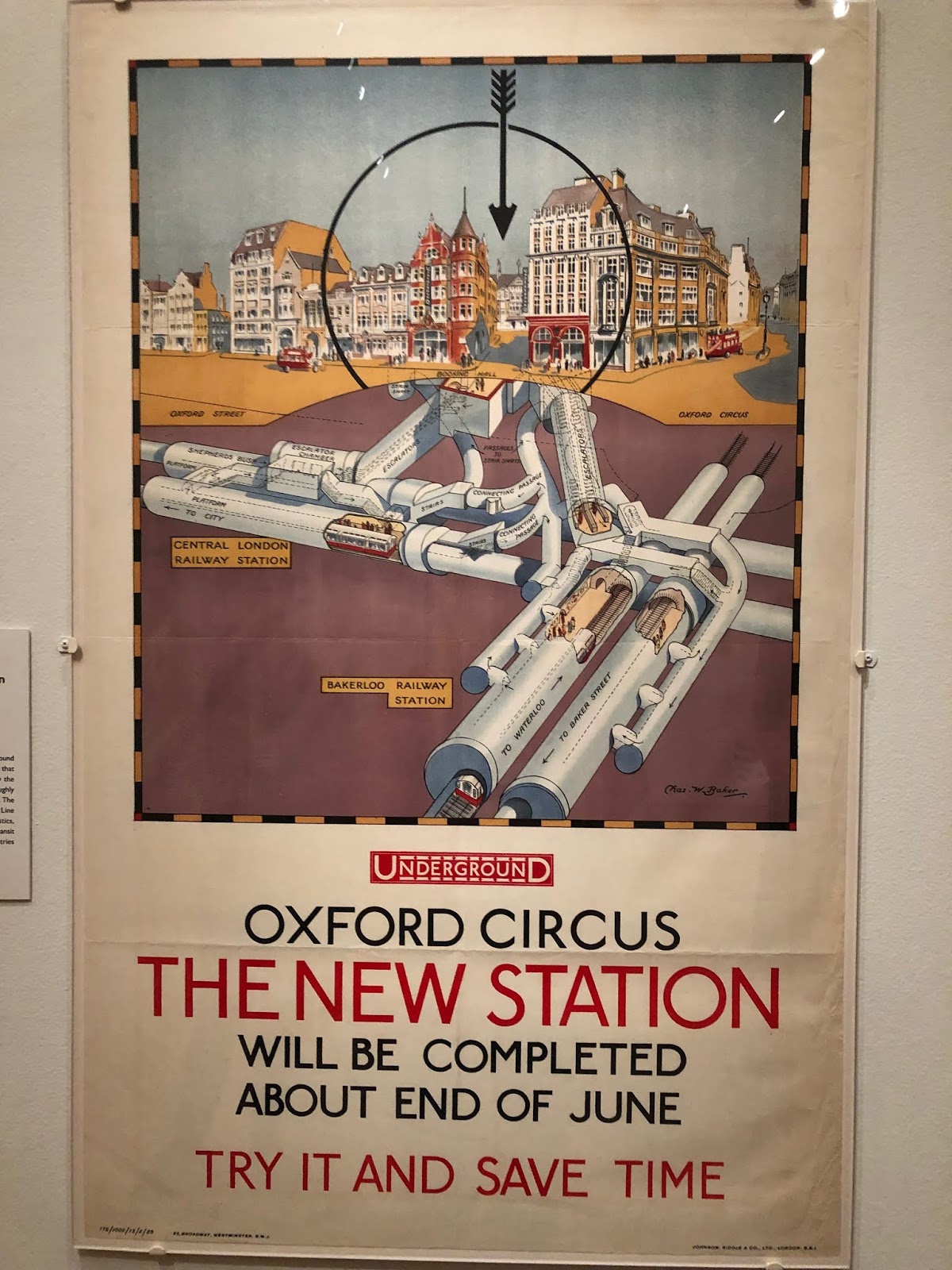
A special Art Institute treat was to discover just before we left that there was a lovely exhibit of London Underground Posters on view.  This exhibit was put together by the British Museum, but we had seen many examples of these charming, colorful, and skillful ads at the London Transport Museum in previous visits to our favorite city in the world. Without a car and never quite flush enough to take a taxi, Jan and I were constant users of the tube and buses.


We have seen literally hundreds of plays in our many visits and traveled to most of them on the tube.


I loved this one as it delved below the surface to show you the complexity of tunnels that exist beneath your feet as you travel.  Oxford Circus was a maze when it opened as it was a crossover between the Bakerloo and Central Lines.  Today it is even more complicated because it is now also a Victoria Line stop. 


We loved this one for its colors and the fact that we spent time in London during the spring on several of our trips.  And also because Kew was my mother's favorite spot when she visited us in 1971-72 while we were living there.


Later that day we had a lovely dinner with two of my now also retired Monmouth College colleagues
and their spouses.  We are so blessed to have made so many close friends during our working years and that we  have been able to continue sharing their lives even though many of them are dispersed around the country now.


Thursday, March 28, 2019

Book Review of BUILT by Roma Agrawal


Built by Roma Agrawal

Built is a lucid well written book on a subject that would frighten most folks—i.e. the complicated high end world of engineering with its dependence on math, physics, chemistry, computers, and history.  Undaunted into this subject comes Roma Agrawal, a woman in a traditionally male profession,  who has a remarkable gift for explaining the most complicated things using clear prose and simple examples. The scope of her discussions covers literally the entire history of structures from the Stone Age to modern skyscrapers.

Did you know the complex history of the simple brick, the structure of the arch, or the creation of  bridge spans, sewers, and skyscrapers?  Roma covers them all with supreme ease and a nice sense of humor about her position in conference rooms the world over as the only female in large groups of men.  

If you have done any kind of world traveling, you can truly enjoy this book because you’ve seen a lot of the structures she talks about like the Pyramids, the Pantheon, the Eiffel Tower, the great Cistern in Istanbul,  and the Gherkin and the Shard (which she helped design) in London.  But mainly it was her lucid explanations and wry humor that appealed to me.  I mean what author can get away with a whole chapter devoted to the “Turd Trade” and can put it to rest by simply noting “That’s probably enough of poo.”

Thursday, March 21, 2019

Lost City of the Monkey Gods Book Review


 Preston, Douglas    Lost City of the Monkey Gods                            

Archaeology and Anthropology have been in my blood since college. The theatre kind of sidetracked me for some forty years, but I remain today an avid consumer of the life and lore of ancient societies.  The cover of the Lost City of the Monkey Gods jumped at me and almost immediately I was immersed in the  search for a hidden city lost for five hundred in the tropical jungle of Honduras. The early chapters of the book recount early legends and the search for this city over the last hundred years. Then with the introduction of new ground coverage penetrating radar and satellite imagery enough evidence was produced to set up a ground expedition to visit it.  

Then came chapters devoted to the expedition itself.  We learned about the difficulties of securing the necessary permissions and permits and then about the logistics for establishing a camp in an area of unexplored jungle that was deemed to be filled with poisonous snakes, predatory mammals, and hordes of nasty insects.  The city was there and there were even undisturbed artifacts to preserve.  

As the public and other scholars learned about the discovery efforts were made to attack the scientific credentials of the explorers, but they persevered. Unfortunately, while fighting the public relations battle, a number of members of the team came down with a dangerous and life threatening tropical parasitical disease. The affliction has been traced all the way back to the dinosaurs and is still a scourge in many jungle environments.  A complete cure has not been found even today.  

At this point the book shifts to a discussion of pandemics in human history and how they spread. The prime exemplar was the decimation of New World populations by Old World conquerors carrying diseases which the New World population had no immunity to. Preston feels that our new problem is that the current First World is faced by a potential attack by Third World diseases. He observes that as the climate warms tropical diseases will begin to infect more and more northern latitudes. Aids, Zica, West Nile, etc. are increasing as the climate warms. The sand flea that carries the Leish parasite (which infected the expedition members) has now been recorded as far north as Oklahoma.  

While starting as a thrilling story of archaeological discovery the book turns into a scary trope on the next possible threat to world population. Fascinating.   


Featured Posts

Review--Smiley, Jane. Lidie: The Further Travels and Adventures of Lidie Newton

  Smiley, Jane . Lidie: The Further Travels and Adventures of Lidie Newton This is a 2 nd novel covering the life of Lidie Newton. In pre...