Wednesday, February 04, 2015

Please Stay on the Trails When You Hike

With another perfect day in the offing we headed once again for an 8:30 morning walk at Tucson Arizona's Sabino Canyon. The route took us on an approximately three mile loop up the Esperero Train to the Bluff Trail, then to Sabino Dam, and finally back to the visitor center. 

Our most important nature lesson of the walk had to do with these strange little pictures of dirt.


This deposit of blackish crust on the desert floor is a living growing substance called cryptogamic or biotic desert soil.  It is what holds the desert floor together and can take 30 to 50 years or more to grow and form. One careless hiker stomping through it can erase many years of patient development in seconds. If you want to know more about this critical element of sparsely vegetated ecosystems you could look at this site http://science-ed.pnnl.gov/pals/resource/cards/cryptogamic_crust.stm  Our naturalists all tied this type of soil to the importance of staying on the trails so as to not interfere any more than you have to with the natural surface. This was new to us and for the rest of the hike we were all looking for patches of this important desert material. And of course we exercised renewed caution in where we were stepping.

Some of our other morning highlights

Ann, our main guide, brought us a bag full of barrel cactus fruits from a plant in her own yard  to taste. In nature they look like this.


She had cleaned them up nicely and here one of our group prepares to take a bite. I had a taste too and found them rather sour but not completely unpleasant. 

Bird sightings are always a part of these walks. Today we saw a nice Gila Woodpecker on the top of a Saguaro.

 
And a nice Anna's Hummingbird on the top of a branch.

 
It continues to look like an early spring and more and more desert plants are showing signs of buds and blooms.  Yesterday we only saw single bloom on a Globe Mallow. Today we ran into a whole bush full of blooms.  Lots of little butterflies were swarming around it as well.


This bright little thistle looks almost like a dandelion. I don't know its true name.
 
This is a plant called Filagree and it has tiny delicate little purplish pink flowers.


After negotiating the Bluff Trail we ended up once again at Sabino Lake.  The dam that created the lake was built by the CCC in the 30's,  but sedimentation over the years has turned it pretty much into a small pond that is still pretty, but clearly no lake.

 
I caught this young fellow checking out the depth along the shore. 


Down below the dam the recent rains are continuing to feed a lot of water into the lower part of the creek.


Some features of the streambed go back much further than the Great Depression era. Below you can see a depression used as a metate by ancient dwellers for grinding seeds or grains as they camped on the shore.


Our luckiest sighting of the morning was a white tailed deer resting peacefully on the hillside and staring right at us.  Our guide noted that the deer do like to come down into these areas because they know that the presence of people also keeps the deer's main predator, the mountain lion, away.
That knowledge was tied to the fact that hummingbirds like to build nests near hawk's nests because the hawks have no interest in hummingbirds, but they do keep the area around their nests free from snakes and other predators who find hummingbird eggs attractive. 
 
 
That's it for today.

Tuesday, February 03, 2015

Sabino Canyon Shines in the Sun

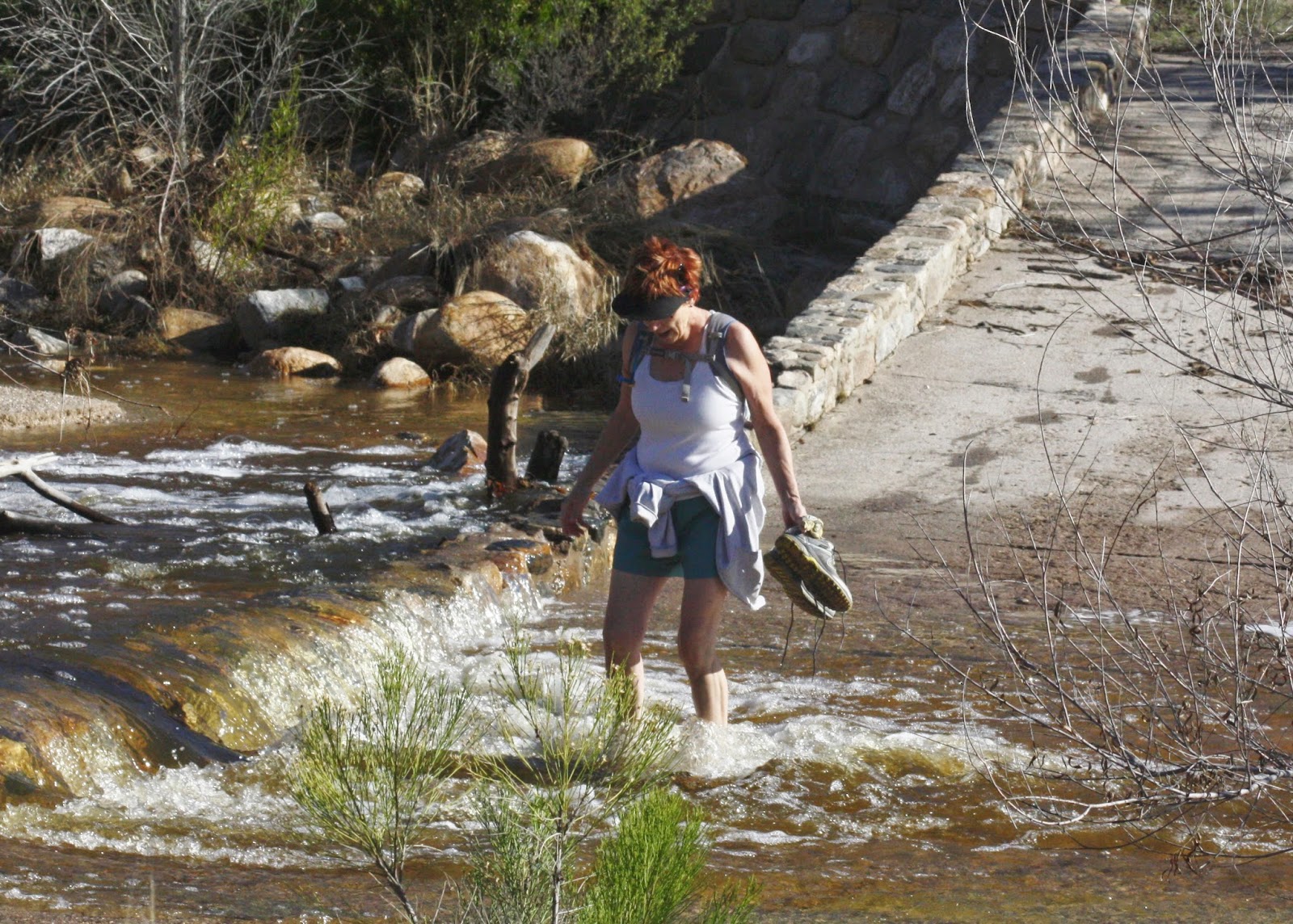
We are now tending to walk in Tucson's Sabino Canyon at least three days a week. Each time we set out there is something new or different to see.  Today's ramble took us down the Bear Canyon road as far as the flooded bridge and then along the rain swollen creek to the dam.  Some folks were brave enough to wade on through.


As we approached the dam you could hear the water thundering as it poured over the top.


Just upstream of the dam we saw a Cooper's Hawk nest that has been there for quite a while according to our guide.


Then one of group members spied a Great Horned Owl sitting in a tree and staring over at the nest about 50 yards away.


Shortly after that a Cooper's hawk landed in the same tree and started kicking up a commotion.


For the next twenty minutes the owl sat as still as a stone while the hawk sputtered angrily while moving to various spots around him. At some points they could not have been more than five feet apart. It was still a noisy standoff when we started back to the Visitor Center.


On the walk back we found some tantalizing signs of early flower blooms like this little red Globe Mallow
 
 
and a single tiny pinkish  Filaree.  
 
Some Fairy Dusters also put in an appearance.
 
 
Even some of the deathly looking stick-like Ocotillo are starting to sprout a few leaves.


It was truly a day to remember at Sabino Canyon.
 

Monday, February 02, 2015

Desert Museum Still Five Stars


We had not returned to the Arizona-Sonora Desert Museum for a couple of years, but when a friend came to town, it was first on our list of attractions for her to see.  Once again we were not disappointed.

The view down into the valley remains awe inspiring. 
 
The volunteers are friendly and knowledgeable. 
 
 
The shows in the auditorium are kid friendly as well as informative.


This guy was posing like a pro.


And of course the humming bird enclosure always pleases.


But the frosting on this overloaded cake remains the soaring free raptor flight demonstrations at 10 and 2 every day.  They are worth the price of admission alone.


Food and drinks at several price levels is available inside; a picnic area is just outside the turnoff into the parking lot and could be used before or after your visit.   The northern entrance road is still narrow and filled with tight turns and dips. Take it easy and watch out for bicycles.  


Sunday, January 25, 2015

Agua Caliente Hits the Spot


Are you tired of the desert?  Do you relish a small pocket pond ringed by huge exotic palms?


Do you crave a cadre of ducks and other water fowl swimming languidly about?  


If you do, then visit this oasis in Tucson’s Agua Caliente Park.  A natural spring has created this water filled anti-desert right on the outskirts of Tucson. It is also a bird filled environment that can be enhanced by taking one of the Audubon Society walks that are scheduled weekly.  

Try it, you'll like it.

Wednesday, January 21, 2015

TIS A HARD TALE The Stonecutter by Camilla Lackberg


TIS A HARD TALE

Just finished another novel by Camilla Lackberg called  The Stonecutter.

The action is once again centered in the seaside Swedish town of  Fjallbacka where the semi-functional police department labors to solve the death of a seven year old girl.  We open on the finding of a body in the sea and then shift to 1923 where a stonecutter in a local quarry finds himself in a sexual relationship with the conniving daughter of his boss.   

Lackberg alternates these two seemingly disconnected and time separated events until they coalesce in the present for the surprising finish.  Almost immediately in the present day plot we discover that the young girl did drown, but the water in her lungs was fresh thus pointing to a murder rather than an accident. The lead investigator, Dectective Patrick Hedstrom, struggles to find a motive for the killing and while doing so we meet up with a ragged assortment of dysfunctional families—including his own.  This may be socialized Eden Sweden,  but the suspects all suffer from a broad gallery of physical ills and psychic disturbances ranging from extreme religious conservatism and autism to child beating and pedophilia.  Under the idyllic exterior sits a seething caldron of dystopic fury.  

Initially it is hard to see how the title of the book fits into the murder investigation, but slowly you do begin to see that the stories of the multiple families all demonstrate what happens when hardened attitudes rule.  Stone has no give; it must be hammered and split.  In Lackberg’s world human behavior hardens to rock and when it breaks it releases unforgiving  cruelty, vengeance, and violence.   Her villains seem to have monsters locked in  their skulls and the victims pay and pay by suffering at first and then returning the suffering to new generations.  

Put this together with the cold bleak Nordic landscape and you have a chilling story that is only partially redeemed by the discovery of how important parental love is to the family and the body politic.   


Monday, January 19, 2015

Sabino Canyon Mementos

We are currently snuggled less than five minutes driving time from Sabino Canyon.  Our morning walks generally begin in a bit of a chill but by 9:30 or so the AZ sun has warmed enough for jacket shedding. Last week, during Ned's Nature Walk, we had the uncommon pleasure of seeing the canyon in a heavy fog and it changed the view remarkably.  First a fairly normal view.
 
Now what it looked like last Wednesday morning as we set out.


About an hour and a half later it started to lift and we were soon back to normal.


It was quite an experience.


Sunday, January 18, 2015

Digging for Richard III by Mike Pitts


“Who would have thunk it?”  Certainly the professional archaeologists did not really expect to find the undisturbed grave of an English King waiting contentedly for them in the first trench they dug underneath a parking lot in Leicester, England.  The story of the discovery and ultimate DNA confirmation that “skeleton 1”  under that tarmac was most certainly that of Richard III, looser of the Battle of Bosworth Field,  is told by journalist and archaeologist Mike Pitts in a nicely balanced  way that removes some of the interpersonal infighting and media hype while retaining the narrative core of the search.  Pitts gives you enough history to set the scene and enough archaeology to put perspective on the science. At the end he fairly notes that finding the grave may add little to history as a whole, but does personalize Richard in a way that adds to our appreciation of his story.  It certainly continues to fuel the age old debate on how accurate Shakespeare’s portrait was and may even prompt some directors and designers to take these findings into consideration when casting and producing the play in the future.    

I have a few quibbles for publishers Thames and Hudson. The type face used was too small and this made the footnotes even smaller.  I finally had to resort to a magnifier to peruse them.  Saving paper is environmentally important, but a few more pages using larger type in this reasonably slim volume would have been appreciated by this aging pair of eyes. I was also disappointed by the limited number and quality of the illustrations. Most of the pictures are in black and white and often lack contrast.   Perhaps permissions for better pictures were restricted by other copyrights, but since there was considerable media filming throughout the entire process it seems strange that the illustrations accompanying the text were so few and so lackluster.

On the whole it still remains a stimulating and rewarding read for a history buff or theatre historian.  I give it 3 ½ stars.

Featured Posts

THE SUNSHINE BOYS by Neil Simon

  The Sunshine Boys by Neil Simon We made a Grand Living group trip to see Neil Simon’s 1972 The Sunshine Boys last week at the TKM Theat...