Sunday, January 22, 2023

The Marriage Portrait


The Marriage Portrait by Maggie O’Farrell.

Have you ever wondered how a 300 page novel can be created out of a 19th century poem that describes a 16th century Italian painting? If you have, then The Marriage Portrait is the book for you.  As the heroine notes toward the end, her  “place is filled, her portrait will take up her role in life.”

Though it is beautifully crafted, I feel if you are a woman, you will be more emotionally attuned to Lucrezia's inner life struggles. O’Farrell seems to have hit on the 16th century as the ideal place for her to write about women whose stories have been overshadowed by the men in their lives. If you have read her Hamnet, you will remember that it focuses on a woman (Shakespeare’s wife) who languishes in Stratford while the supposed real life is going on at the Globe. The main difference between the two stories is that Shakespeare just ignored his wife whereas the Duke of Ferrara set out to kill his wife and deny her any sense of an inner life. Others have spoken eloquently of O’Farrell’s rich imagining of 16th-century Italian courtly life and her lush imagistic prose, so much so, that they have claimed her work is worth reading just for that element.

In spite of this I must admit I found it hard to stay involved. I finally put the book aside for almost a month before going back at it.  When I returned, I realized that the first two hundred pages tell us our heroine  thinks she will be killed by her husband and then tries to sustain the impending doom by jumping the narrative back and forth in time. By coming back to the book some weeks after I started it, I was able to forget how long the murderous thought had been pushed forward only to be pulled back by returning to a time before it was uttered. Now, with the early struggles a dimmer memory, I was able to luxuriate in the final rapid and surprising denouement with ease. Score one for keeping at it. 

One final requisite for any reader. You need to read or re-read Robert Browning's glorious poem "My Last Duchess." The entire book is all there.  


“That’s my last Duchess painted on the wall,

looking as if she were alive”


Thursday, December 29, 2022

The Thing in the Snow by Sean Adams


Three people are employed as caretakers in a mothballed research center somewhere in the arctic. They are supplied by helicopter once a week, are cautioned against going outside, and spend their days doing make-work jobs like checking the doors to see if they work, or chairs to see if they are sittable.

Thirty-eight pages into this book, that is described as “mesmerizing” on the cover, it becomes just plain numbing.  The characters are semi-zombies, the setting is bleak, and the dialogue is stiff.  Life is too short and the number of available books too large to keep reading one that fails to interest the reader.  I found myself not really caring whether there was something in the snow or not. Now it might get better later, but I am not inclined to wait that long. If you wish to discover more about The Thing in the Snow, go for it. It is back in the library.  

Jim De Young   12/22/22


Sunday, December 18, 2022

The De Young Family Christmas Letter


Volume XLIX                                                                                                 December 25, 2022


Christmas 2022

We begin this 49th epistle on the surprising note that the most-read post on my blog (stirringthepudding.blogspot.com) in the last year was the one about moving to Iowa. Hardly anyone but our daughter knows us in Iowa, so the high readership must have come from folks in Illinois who were happy to learn that they had finally gotten rid of us. 😊 No, not really. That’s a joke, because the worst thing about our move to Iowa has been the severing of daily ties with the many close friends we made in Monmouth over the years. 


We remain convinced of the truth in Tom Stoppard’s admonition from his play Arcadia that “Life goes only forward, never back.” Accordingly, we now reaffirm that our journey to Grand Living at Indian Creek was the right decision at the right time for us. Beyond that there was satisfaction in the decluttering required in making the move. Only those who have accumulated stuff by living in the same large house for fifty years can know the freedom that comes with trying to adopt the philosophy of the guru of the Arts and Crafts movement William Morris who said long ago “Have nothing in your house that you do not know to be useful or believe to be beautiful.”

This brings to mind another quote. “If you want to change the world, find someone to help you paddle.”  Now I doubt we have changed the world, but I have had a fellow paddler for 63 years of marriage. My wife Jan has been the mainstay of our family and my life. She is once again branching out to make a difference in our new community. She helps run a reading and writing group in our building and is committed to helping new residents acclimate to life here. Meanwhile, we are both helping to keep the community library in order and going outside our residence to help in our daughter’s first grade classroom. Jim will be joining the resident council here in the New Year and continues to write a family history and finish a murder mystery novel that he started twenty years ago. And, would you believe it, both of us are involved in a play to be done at our Christmas Eve celebration.

Our daughter Amy and her husband Todd continue to live in Marion, IA, about a ten-minute drive from us.

 Amy still teaches first grade at Hiawatha Elementary School in Cedar Rapids. Challenges remain in all levels of the educational system, but she has the talent, commitment and resiliency to face and conquer them in that most critical period of early schooling. Husband Todd has continued to deal with major back problems. He has had more surgery this past year and now has added water therapy to his list of remediations. Even though he is now officially disabled, it has not kept him from doing a lot of the household cooking and making deer jerky for his friends. 

Their son Mikel is now a junior at the Upper Iowa University.

We feel he has become a more committed student this year. He has narrowed his career focus down to the environmental resource area and has found some professors who are mentors. He hopes to work for the Iowa DNR again next summer.  

Taylor Brown, who in his youth was TJ Brown, continues to work for the Baytown, TX, fire department as a firefighter/paramedic. He recently attended classes to update his national paramedic credentials and we have just heard that he has received the Baytown firefighter of the year award for 2022.  This was partially for his leadership of the department’s Explorer Troop, which focuses on introducing young people to careers in firefighting and emergency medical care. What an honor!   

 Meanwhile, in far off Helsinki, Finland, our son David, his wife Lotta, and their family continue to grow.


 And when I say grow, I really mean grow as David and Lotta are expecting their 3rd child in early January. Daughters Frida and Selma, now 10 and 7, are growing too.  They can take hikes, ride bikes, hunt mushrooms, cook, skate, ski, and play the piano. Their lives are just plain full of school and outside activities.  Covid still lingers and David continues to work from home a number of days each week. On the other hand, business travel is picking up again, and he was sent to Singapore last month, He has also completed an MFA degree in Poetry offered by New York University in Paris, which goes along I guess with his degree from Grinnell College ages ago. That does remind me of a student from long ago who said “I’m going to graduate on time no matter how long it takes.” Lotta also continues to study and does private gestalt therapy appointments. We miss all of them every day.  

And that’s the year that was. We have been blessed in our own lives this year and wish the same to you.  That doesn’t mean we have forgotten about the terrible war in the Ukraine or that our planet remains locked in a battle to salvage a livable environment. We can continue to think about the challenges ahead even as we celebrate our own good fortunes at this holiday season.      

 Jim and Jan De Young

e-mail us at dramajim@gmail.com or  janetwdeyoung@gmail.com


Sunday, December 11, 2022

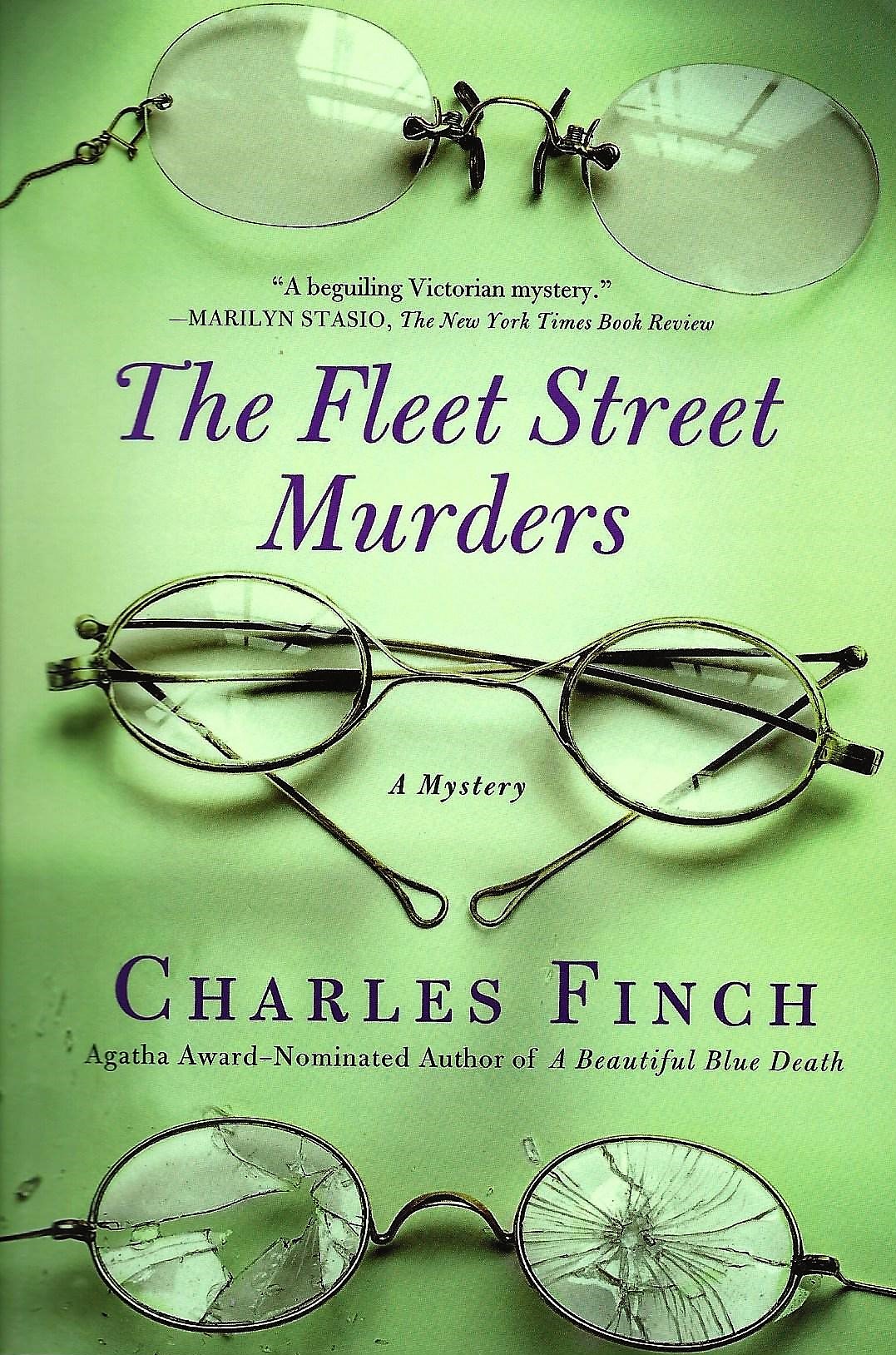
The Fleet Street Murders by Charles Finch


The Fleet Street Murders by Charles Finch is the ideal Victorian outing for readers who prefer their  detective novels pretty much free of gore, violence, swear words, and sexual escapades. The upper-class amateur sleuth, Charles Lenox, is a likable aristocrat who has a knack for treating people from all levels of society with respect.  He is carrying on a courtship with Lady Jane Grey that is so chaste that it would seem downright amusing if it were not taking place in Victorian London.    

There are two plots and both, thankfully, can easily be kept track of. Mr. Lenox is running for a seat in parliament in Stirrington, a fictional location well to the north of London. This gives you the added opportunity to soak up details of how by-elections were run in those days. Meanwhile a mystifying double murder of two newspaper men in London keeps drawing Lenox back to town to grapple with a villain who he has wanted to pin multiple crimes on for years.  

Finch gives you the just right amount of local atmosphere to make his country settings come alive and they are populated with the kind of wonderfully quixotic characters that always seem to inhabit them. On the city side, anyone who has read London history or visited the city, will revel in Lenox’s visits to Berry and Rudd, Wine merchants and the famous Cheshire Cheese public house just off Fleet Street.

This is the third Lenox mystery and like a cup of warm cocoa before bedtime, it will bring a sense of cozy satisfaction.  I am going to search out the first two.  

Jim De Young    12/11/22

Friday, November 25, 2022

Miracle of the Music Man


Mark Cabaniss’s Miracle of the Music Man does a fine job of stitching interviews and research into the  story of Meredith Willson’s life and career on the Broadway stage. There is no doubt that Willson (with two L's) has become--America’s classic Music Man, but Cabaniss admits in the last pages of the book that his career “started at the top and went progressively downhill.” Unfortunately, this makes for a book that follows the same pattern.  

The material on the making of the iconic musical is filled with drama and inside bits about the struggle to get the show mounted. Right off the bat we learn that one big turning point was when the title was changed from Music Man to The Music Man.  We also learn a lot about Mason City, Iowa, Willson’s family and musical training, his radio career, his stint with the John Philip Sousa band, and finally about performing in the NBC orchestra of Arturo Toscanini.

Like most musicals, The Music Man went through years of re-writes and multiple producers before achieving even the status of a potential Broadway Show. Especially interesting to me was the evolution of the character of Winthrop from a character in a wheelchair to a boy with a lisp, and the story of how Robert Preston got the part of Harold Hill.  Preston is quoted as saying until he got the part, he had been playing “the lead in all the B pictures and the villain in all the epics.”  The story of how the barbershop quartette, The Buffalo Bills, got the job is another intriguing inside bit.  

I must admit to never hearing or seeing the term “gypsy run-through” before. It is apparently the name given to the final run-through of a show in front of an invited audience before it goes on the road to try out before hopefully returning to New York and opening on Broadway. I also learned that composers have songs in what is called their “trunk.”  They have been written and not used or have been discarded from a show and await repurposing. Willson admits taking two or three from the trunk to use in the score for The Music Man. Till There Was You” was from the trunk, as were many versions of what turned out that most compelling rhythmic talk song “Ya Got Trouble”.

As implied from my comment in the first paragraph, the reader in a hurry can probably stop two-thirds of the way through the book and not miss much other than the reasonably successful run of The Unsinkable Molly Brown, the disappointing Here’s Love, and the failure of 1491, which closed before ever reaching Broadway. However, if you have a soft spot in your heart for River City, you can certainly take a quick dip into this readable biography of a man and a musical that continues to hold thousands of theatre goers in its grip through its professional revivals and amateur productions around the globe. Three and a half stars.


Tuesday, November 15, 2022


THE SWEET REMNANTS OF SUMMER by Alexander McCall Smith

Mr. McCall Smith has written over 70 books. “His No 1 Ladies Detective Agency” series runs to 22 entries and his “Isabel Dalhousie” Series runs a close second with 14 books.  The most recent Dalhousie novel is titled The Sweet Remnants of Summer and it is a pleasant read.    

The heroine, Isabel Dalhousie, lives in Edinburgh with her husband, Jamie, a musician, and their two young sons. Isabel is a philosopher by trade and edits a publication called “The Journal of Applied Ethics.” She has often tried to make up for being independently wealthy by being a helper. As such, she has attracted a reputation for solving other people’s personal problems, but that does not keep her  bassoon playing husband from believing that she may be a bit too aggressive in her willingness to “get involved” in the lives of others.

If you are getting tired of books about serial killers or politicians who insist that all of their opponents are evil, lying, monsters who eat babies in their spare time, a McCall Smith book is an answer to your prayers. It comes with the fresh breeze of a Scottish summer and a love for the sights, sounds, and architecture of Edinburgh. The book is short enough to not demand a commitment of six weeks of hard labor to finish.  It also brings a gentleness, a sense of humor, and an approach to life that fills each of his characters with a sense of what might be if we all could just get along better with each other.

Ms. Dalhousie is the very model of a modern major woman, and as a philosopher, she sees moral dilemmas everywhere. Jamie, her husband, thinks she should stay out of helping people with family disruptions. This occurs even though, at the same time,  he would like to do something about the fact that he believes the conductor of his orchestra will be appointing an unqualified person to a position of importance. A third plot line begins with Isabel’s son’s teacher reporting that her son has bitten a classmate.  All three of the threads combine to make for philosophical considerations of motive, guilt, lying, and penchants toward solving problems with violence or revenge.   

I like these characters. I like this kind of story and I like the thought that we need poetry, kindness, and love to guide our lives. With the winter’s snow descending, we need more of all of those virtues, while we await the coming of spring.

Jim De Young  11/15/2022


Wednesday, October 26, 2022

THE SACRED BRIDGE by Anne Hillerman


Given my love affair with Arizona, it is not surprising that I jumped like a desert jack rabbit to read Anne Hillerman’s seventh Joe Leaphorn Jim Chee Bernadette Manuelito novel titled The Sacred Bridge.  If you are counting, there are twenty-five books in the series when you consider the eighteen written by her father Tony that started this long run. Several of the earlier ones were adapted for public television some years back.

In this book we are once again in the heart of Navajo country and we continue to get a full measure of rich history combined with the incredible natural beauty of Lake Powell and the entire south-west. You can open the volume to almost any page and find descriptions like this.

“The desert light and colors fed his spirit; the contrast between the azure sky, the deep, deep blue water shimmering in the sun, the startling white of three small clouds that drifted overhead forming shadows on the lake, the sandstone’s warm brown, vibrant red-orange, and black desert varnish.” 

My own enjoyment was enriched by having visited Lake Powell, Rainbow Bridge, Antelope Canyon, Shiprock, and Page. They all figure prominently in the book’s intricate double plot. The first thread finds Officer Jim Chee on a holiday in the Lake Powell area looking to find a cave mentioned by his mentor Joe Leaphorn while also trying to decide whether he wishes to pursue new life directions. On a trail near the Rainbow Bridge, he looks down into the lake and sees a body.  Atop a cliff he also finds an empty tent and a cache of ancient artifacts. Although not on duty, he must report it. That in short order involves him in the investigation of what looks increasingly like murder.

Meanwhile, back at Shiprock, the second plot begins with Ms. Manuelito also finding trouble when she witnesses a fatal hit and run accident. The victim has no id on him, but does deposit some drugs in Bernadette’s car just before he is run down. Her attempts to identify him and the driver of the deadly car lead her into a dangerous undercover assignment on a medical marihuana farm that has been started on the reservation.

The book moves seamlessly between the two cases with two unifying factors. Bernadette is also deliberating a major career change and both of them find themselves in life threatening situations. The wrap-ups afford a plentiful galaxy of twists and you end with new knowledge about the duo and plenty of hints that could lead to further adventures for both of them. I loved this book and give it ***** five stars.  

Featured Posts

God’s County by William Kent Kreuger

    My quick first thought about this book was that Kent Krueger now shares a useful symbol with Louise Penny. Both writers have promine...