Wednesday, November 25, 2020

HEAVY HEAVY--The Warmth of Other Suns


Heavy, Heavy,

If you are looking for something light to read, Isabel Wilkerson's  2010's The Warmth of Other Suns  is not  one you are going to put on  your short list. It is heavy in weight (some 500 pages) and  in challenging content..  If you are white and feeling pretty good about how you managed to succeed in spite of challenging circumstances, it will also be a rather nasty wakeup call. 

Should you decide to take up the challenge, you can start with the knowledge that writer Gay Talese called the book--“A seminal work of narrative non-fiction.”   My start will be to note that I finished it on the same day that President Elect Biden announced his first cabinet picks. Among them was the appointment of a  long time African American diplomat to be Ambassador to the United Nations.  Her story along with the story of Vice President Elect Harris, could easily be included as examples of the slow but hopefully steady continuation of what has now been called  the “Great Migration.”  Wilkerson said her central purpose was to tell the story of this vast population shift and emphasized that it did not come from abroad but from within the country.  From  WWI  all the way into the 1970’s several million  African-Americans moved out of the  Jim  Crow South and into the rest of the country.  Wilkerson also wanted to change the emphasis of past studies on this migration from demographic statistics, sociology, and politics to the more personal telling of  the life stories of those who dared to make and survive the journey. And for me that is what makes the book readable as a narrative rather than an academic tome. 

To do this she settled on three archetypal African Americans out of the many she interviewed. Then she distributed their stories in small snippets while filling the spaces in-between with the historical contexts they were living through.  Readers will meet a flamboyant MD,  Robert Joseph Pershing Foster, who drives alone in his Buick all the way to California from Louisiana to start a new life. They will  meet George Swanson Starling, a bright young fruit picker just starting his education, who has to flee Jim Crow retribution for his activism and finds himself working for the rest of his life on a rail line that plies the coast from his native Florida to the Big Apple.  And finally you will meet the lynchpin character, Ida Mae  Brandon Gladney, a sharecropper’s  long suffering wife,  who travels with her husband and their two children (with another on the way)  north on the Illinois Central to exchange  their no win cycle of poverty and violence for a  new life in the teeming tenements of  Chicago’s south side. 

Though each of these three suffered from the political, social, and economic  reality of the racist Jim Crow South,  each of them also faces the more subtle but equal racism in their new homes.  

Ida Mae called up the most emotion in me as her struggles center in the very Midwest that I grew up in. Dr. Foster’s journey hooked me because he was  flamboyant and theatrical.  There was a familiarity there as well because on  his drive to California  he went through Lordsburg, NM, a town my wife and I have driven through on Interstate 10 every year for the past five years on our way to winter in Tucson.  Foster’s experience in Lordsburg  was heart wrenching as he searched futilely for a hotel or motel that would rent him a room, while our experience many years later has always been pleasurable as we passed through. George Starling was for me the most tragic because he was intelligent but ended up  traveling back and forth between his new home and the place he left without ever managing to gain what he had started out wanting the most—a formal education.  

All three of these brave folks, who dispersed to every part of our land, blend together to tell the indelible truth that white America has not made enough progress yet to rid itself of its systemic faults.  The courage of these migrants to leave their birth homes, to survive in an entirely new environment,  and yes to succeed there amidst a system that was designed to block their every attempt to rise,  is ultimately a sign of hope for me.  There must somehow be a way to find some light at the end of our tunnel of shame. .

 Was the “Great Migration” worth it?   Did the millions just trade one enslaved condition for another equally as bad?   Wilkerson agrees that initially academic studies said that the migrations solved nothing and just transported the problems of the South to the North.  But she then goes on to argue that those conclusions were in error.  A modern re-study of the data shows her that the migrants were not just bringing the same unrest to their new homes.  She claims that on balance the migrants were more educated than their northern competitors, that their families were more socially stable,  and that they were  more likely to earn better salaries because they were willing to work harder and longer even in less desirable jobs.   In other words the migration moved the most able , the most dedicated, and the most resilient  to the new lands  where they didn’t necessarily prosper, but where they were at least able to recapture some dignity and wisdom that could be passed on to the next generations.    

There is  much more in this beautifully written and moving study,  but I will leave it to you to find those for yourself.    


Monday, November 23, 2020

Where Was I When Learned of JFK's assassination?

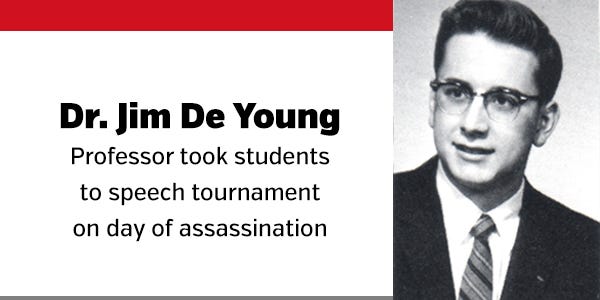
 According to Monmouth College Historian Jeff Rankin only eleven people are in town now who were at the college on Nov. 22, 1963 when John F Kennedy fell victim to Lee Harvey Oswald's bullets in Dallas, TX .  When asked to comment on where I was on that fateful day and how it connected to the college, I  sent Jeff the following.  . .    He added the loverly picture of a young guy without a beard who has aged only a little in the past sixty some years. 

Image for post

I DO WELCOME THE CHANCE to relate again the story of how and where my wife and I experienced the traumatic experience of John F. Kennedy’s death because it was indelibly connected to our lives, the college and its students. At my faculty retirement sendoff party in the late spring of 2002, my short talk included the observation that unfortunately my career at Monmouth College was bookended by tragedy. 9–11 occurred just after the start of my final year of teaching and John Kennedy was assassinated in the fall of 1963 just as I embarked on my first year.

Tom Fernandez and I were hired to teach in what was then called the Speech Department by Jean Liedman (yes the one the dorm is named after) beginning in September of 1963. Tom was an experienced Ph.D. and took over as head of the department so Jean (Miss Liedman) could devote more time to her duties as Dean of Women. I was a greenhorn instructor and slotted to teach some speech and direct the college theatre program. Dr. Fernandez was an avid promoter of competitive speech activities such as Debate, Extemporaneous Speaking, Oratory, and Oral Interpretation and immediately started to prepare some of our new students to compete at the Bradley Speech Tournament in November. My wife’s parents lived in Peoria (thus a free bed and meals that the college didn’t have to pay for) and we were quickly recruited to drive some of the competitors over to the Tournament.

That fateful Friday morning we loaded three MC students into our back seat and headed out on old Highway 150 (no I-74 freeway then) for Peoria. As we drove into Brimfield (again yes you had to drive though towns not around them in those days), I noticed that I could use some gas and pulled into the town’s little Standard station. While the attendant filled the tank (self service was not even a gleam in anyone’s eye back then), I went into the station to pay. A tiny screened black-and-white TV high on the wall in back of the counter was on and I looked up and heard a serious looking announcer say that they had just had a report that the president had been shot in Dallas. I returned to the car and told my wife and the students. We immediately turned the car radio on to hear bulletins as we proceeded on to Peoria. When we arrived on the Bradley campus, I parked outside of the Student Union. We rushed in and quickly found a large room packed with students and professors mostly sitting on the floor and watching a single TV set in stunned silence.

The speech tournament actually went on that weekend as students had come from several states to compete, but there was a weird pall about the whole affair. The competitors filtered out to do their events and then returned to that TV room to silently watch events unfold. We drove back to Monmouth on Sunday in tomb-like silence. I have no recollection of how any of them did in their events. And that is my “Where were you when you heard that Kennedy was assassinated story?”

I will add this coda. Three or four years ago at a Golden Scots weekend on campus an alum came up to me and said, “ I remember you. I was in your car when you came back and told us that Kennedy had been shot.” We did talk a bit about our experiences that weekend, but I am ashamed now to say that neither my wife or I can recall his name. Maybe if this is published he will come forward again.

Sunday, November 01, 2020

Review of THE ANGEL COURT AFFAIR by Anne Perry


Anne Perry’s The Angel Court Affair is rather thin soup even for this prolific “cosy” period mystery author.  It is billed as a Charlotte and Thomas Pitt novel, but Charlotte and all of the other female characters  (from the Pitt’s daughter to the crusty Lady Vespasia) are sadly left to populate the background,  Mr. Pitt, quite frankly, is far less interesting and more plodding.  He is initially asked to organize a  protective detail for  Sophia Delacruz, a British subject, who has married a Spanish nobleman.  Sophia is a  strident female evangelist, who has raised hackles among traditional Christians in a series of London speeches.  When she disappears and two of her associates are violently murdered, Pitt finds the Special Branch behind the eight ball and  involved in international political disruptions and long dormant academic  and financial chicanery rather than  evangelism. There are as usual some surprise turns at the end, but not much to convince anyone that the revealed buried motives are not stretched pretty thin.  Other than people going to gentleman’s clubs and riding in carriages, the period Victorian atmosphere is also rather minimal.  I give it a weak 2.5 and will, as usual, only pick up a Perry novel when there is nothing more compelling at hand.  


Friday, October 30, 2020

A Review of Jon Meacham's His Truth is Marching On: John Lewis and the Power of Hope


John Meacham notes at the very end of His Truth is Marching On  that he has not attempted to write a full scale biography of John Lewis, but instead “an appreciative account of the major moments of Lewis’s life in the Movement.” I agree with that summation.

We get quick coverage of Lewis’s birth and youth, and then attention to his assimilation of non-violence as found in Christianity, Gandhi and Martin Luther King. Finally we are taken through the major civil rights campaigns that Lewis led or participated in.

One of the things I found appealing in the book is that it summarized for me a series of events that I lived through, but ashamedly did not see or feel as deeply as he did or I should have. This is perhaps not surprising as I was a young northerner who grew up in an almost totally white environment. My own  unconsciousness of racial issues wasn’t really aroused until my senior year of college in 1959 when I saw my first “colored” water fountains and restrooms on a spring break trip to Florida. Marriage, graduate school, new jobs, and a new family kept me conscious of, but clearly not participating in the movement in any significant way in the ten years after that. I wasn’t asleep through those years yet I think now that I probably thought that starting a new independent life took precedence over the struggle Lewis was engaging in. And I have a feeling that I was not the only young white man from the upper Midwest who used that as an excuse in those days.     

Looking back now at Lewis’s courage in the face of constant adversarial challenges is something that stands out on every page of Meacham’s book. Lewis comes off as neither utopian or cynical, but as a realist who was steadfastly willing to take a punch without responding in order to move the fight forward to another round.  Always step forward, never back.

Definitely new to me was how dependant Lewis’s philosophy was on education and on sessions at the Highlander Folk School. This was a philosophy oriented summer camp spearheaded by a labor organizer named Myles Horton. It was integrated and focused on the “love your neighbor” admonishment of Christianity. Rosa Parks went there in 1955 before the Montgomery Bus boycott and at other times Martin Luther King went there, Pete Seeger went there, and even Eleanor Roosevelt went there. John Lewis attended sessions in 1958 before launching the 1960 Louisville lunch counter sit-ins.   

Having just finished reading Caste by Isabel Wilkerson, I am now much more attuned to the systemic racism that Lewis was working against. The fight, as was pointed out by historian Arthur Schlesinger at the time, was to finally attack the white unconscious belief that there was a necessary inferiority in skins of a darker color. Although Plessy vs Ferguson in 1896  sanctioned separate but equal, Justice John Marshall Harlan in dissent was already writing that there was no superior caste in America and that the Constitution is color blind.  And there in a nutshell was the “Movement” of the 1960’s. 

Another strong point of the book was its reminder of just how many forces were aligned against the Movement. We now seem to think that the sixties produced a marvelous groundswell of change and all we need to do is clean things about around the edges. Unfortunately we have mostly forgotten that the March on Washington of August, 1963 was deemed too radical and too strident for over 60% of the American public.  Although Robert Kennedy told Lewis that he had changed his mind after the March on Washington, the November assassination of JFK ushered in the realization that non-violent protest might not be enough.  

Meacham impressively steers us through how difficult it was for Lewis to keep to MLK’s 1961 admonition of “We will meet your physical force with soul force.” On “Bloody Sunday” March7, 1965 on the Edmund Pettus Bridge John Lewis took the first blow from a billy club wielded by a “peace officer” and ended up with a skull fracture. In that year of the march from Selma to Montgomery there continued to be bloody events.   

By 1966 the “Black Power” movement was gaining steam as people like Stokley Carmichael and Malcolm X entered the fray. In July of 1966, John Lewis found himself removed as head of SNCC (Student Non-violent Coordinating Committee)—a group he had heroically led for a number of years. He had become according to Meacham, an “expendable commodity, a former leader.” Lewis was disheartened and backed off. He found renewed relevance by attaching himself to the campaign of Robert Kennedy only to be hit a final hammer blow in 1968 when both Bobby and MLK were assassinated.

That is where Meacham ends his story. There is no attempt to deal with the post 1960’s when Lewis went on to become a political icon in the US House of Representatives and that is just fine. The salient details have been covered. Meacham quotes him as saying then what you have to do is just “Keep pickin em up and putten em down” Always step forward, never back. We are left with the knowledge that the march toward that “more perfect union”  is still sadly unfinished.          


 Aug 63  (we had just returned from a summer in Europe and were moving to Monmouth


Tuesday, October 27, 2020


Three Whodunnits For Some Detective Escape

Between some more meaty books in the last month, I have zipped through a couple of mysteries. Cipher by M.A. Rothman was a totally predictable outing that had excellent FBI procedurals, but a story line that I am pretty much sick of--i.e. sexually obsessed serial killer taking out young women.  Skip this one.

One of my favorite authors for escape reading combined with  historic tidbits from my favorite city (London of course) is Christopher Fowler. He has written a series of books featuring two eccentric old codger British detectives--Arthur Bryant and John May. Their beat is London and the books always feature eccentric humor, strange plots, and tours through the hidden byways of the city you can’t be tired of unless you are tired of life. In Bryant and May and the Bleeding Heart we find the daffy personnel of the Peculiar Crimes Unit trying to figure out why a dead man seems to be walking and why some ghoul seems to be digging up additional graves. This makes a read that is ideal for Halloween.

Fowler often brings theatrical lore into his books and I must admit that The Bleeding Heart doesn’t have a lot of that. If you are a theatreophile like me, look for Fowler’s The Memory of Blood, which features a murder that takes place during a theatrical cast party and is done in a locked room occupied only by the corpse and a life sized puppet of Mr. Punch of Punch and Judy fame. It is filled with delicious theatre history along with an ingenious plot.  


Monday, October 19, 2020

Caste: The Origins of our Discontent by Isabel Wilkerson


Caste: The Origins of our Discontent by Isabel Wilkerson

It’s been a while since I posted a review. The reason is that Isabel Wilkerson’s Caste with its Shakespearean tragedy sub-title is crammed with thought provoking content and illustrated with a cascade of personal and researched evidence. You have to stop and think after almost every chapter.

She chooses the term “caste” because she believes it goes deeper than race, skin tone, or religion in defining the hierarchy of human divisions that you are born into.

A strange derivational oddity is that the word “caste” itself, which we often associate with India comes from the Portuguese word “casta” meaning race or breed. It was applied by the Portuguese to the Hindu caste divisions they experienced  when trading with India.

Wilkerson, a black woman with a widely varying background, concentrates on three main caste systems which she believes have stood out over time. The first and oldest is the still active, caste system of India. Second, is the tragic, officially vanquished but rising again, Nazi campaign against the Jews. And third, her primary target, the unspoken caste pyramid in America that has persisted into the present day despite the legal termination of slavery after the Civil War.

She enumerates three pillars of all caste systems. They are set down by God or a divine presence.  You are born into the system and cannot easily rise out of it. And finally, there is a prohibition against marriage or propagation outside of any caste in order to avoid diluting or mixing the blood lines.

In discussing the history of the German dealings with the Jews, she makes a strong argument that many of the Nazi justifications for their policies were taken whole cloth from the American “eugenics” movement of the late 19th and early 20th century.

She argues that all dominant groups in a caste system are sensitive to threats from below, but the lower the caste the more fearful they become of losing the fewer rungs below them on the ladder. For instance white lower class Americans with less education are extremely concerned with separating themselves from the lower classes of color. She owes this to a fear that the one commodity that separates them (their white skin) is losing value.  If this seems prescient two weeks before our current election I cannot deny it.   

In America the dominant or Brahmin class has been white, landed, and educated. Think of Washington, Jefferson, plantation owners all over the south, and the industrial giants of the eastern sea board. Now put into it the figure of a black man by the name of Barack Hussein Obama, who created what she calls a “supernova of fear and anxiety” amongst both white leaders and the white lower castes.

The election and then re-election of Obama, she argues, has  thrown the white under classes into total panic. The fear of what will happen when the population shifts toward more people of color has shown itself in the hatred of immigrants and the election of a man who is going build a wall to keep the Mexicans out and who will put his foot down on China to save lower class jobs. Conservative American protestants, commonly called Evangelicals, have joined in the chorus of fear and now rail against Muslims, gay rights, legal abortion, and liberal social programs. All of these ideas seem to favor groups who have always been on the bottom of the ladder and now are rising. 

Looking at the same movement from the standpoint of the Alpha class gives you another picture. How does the insecure Alpha behave?  He yells, he screams, he bullies, he attacks, and he lies in order to beat the enemies below into submission. Who does this remind you of?

She also cites studies that 80% of all whites (both rich and poor, both educated and not as well educated) exhibit “unconscious bias” toward African Americans because the American culture has exposed them for so many years to so many myths about people of color.  They are criminals, rapists, lazy, can’t be educated, won’t keep their place, and siphon off all the welfare money. Although the more obvious discrimination of the Jim Crow period has receded, she argues, that most whites still discriminate in unthinking ways.

She goes on to explore the many more ways that the subordinate castes in the United States were kept down not just by skin color, but by economic restrictions.  “Redlining” has kept people of color in the United States from living in certain areas. Banking discrimination has kept them from financing homes or businesses. This combines with well established facts that struggling whites and most blacks get poorer education, poorer health care, and have poorer nutrition by being congregated into food deserts. Ultimately these folks have more untreated health conditions and lower life expectancies than the wealthy. Add this to more stringent policing and more and longer incarcerations and you have a concerted system of underground controls that continue to keep the already oppressed down and in their place. To bring this again to the present, all you need to do is look at the current Covid statistics in relation to who is getting the disease and who is dying more often.

The end result of all of this has been to keep the lower castes  both black and white from accumulating wealth, which in turn deprives them of the most valuable of all traits--POWER. Power is what the top class desires and what it will defend at all cost.

Ultimately she admits that caste doesn’t explain all the ills in this world, but she does insist that it has become hard to understand American life without taking its long lasting and “embedded hierarchy” into account,

She feels that the price American pays for its caste system is ironically a bleaker and less benevolent landscape for all. We have no universal medical care, few family leaves for illness or pregnancy, shorter or no vacations, weaker retirement care, and overall less concern for our fellow citizens than most other developed countries. For an update on this idea you need only to think of the symbolism embodied by wearing a mask as we experience a worldwide pandemic.   

What must we work for? Not a violent revolution, she says, but more effort to at least understand the problem and then maybe to work slowly to manage some fixes. We should search for the humanity of the person in front of us. We are here and now. There is no sense in arguing about whether we are responsible for the sins of our forefathers. We are responsible for the good or ill we do to others who are alive today. We must try and make do with what we have and face up to the present by trying to change what we can change. You must admit above all that you have been born to a certain place in the scheme of things and now must decide whether you wish stay there or accept the challenge of trying to climb out of it.   

Inserted along the way in this stimulating book, are more little tidbits of derivation. For instance do you know the origin of the term “scapegoat?”  It comes from a Hebrew tradition of presenting two goats at the altar. One is killed to cleanse the sanctuary and the other is presented live to the Lord. A culture thus attempts to transmit its sins to the “scapegoat.” Over time the meaning has mutated to seeing the “scapegoat” as a symbol of misfortune for everyone in the scapegoat group. Thus you end up with the Jews blamed for the ills of German society and the  criminal, lazy, welfare stealing blacks and immigrants who are blamed for ruining the fantasy world that never was. These groups whether Jews, Untouchables, or people of color are coming to get you and must be segregated and stopped. Sound familiar?

Another little morsel was the origin of the term “Caucasian.”  It actually comes from a 17th century German medical professor who collected skulls and thought that one that came from the Caucasus was his most beautiful specimen. And thus the name for the fair haired, fair skinned, Aryan white European stock comes from Central Asia.

Sorry this is long, but it strikes me as important to at least consider this view of the world presented by one of those who was born with a weight on her head rather than a silver spoon in her mouth.


Saturday, October 03, 2020

Review Louise Penny's A Rule Against Murder


Penny Louise A Rule Against Murder 2008 4th in the series

I hate to say it, but I have finally found a real clinker in Penny’s long and distinguished list of novels. We find ourselves in a secluded Canadian lakeside summer resort that manages to have Armand Gamache and his wife as guests along with one of the most vituperative and vile families you can imagine. Very few of the Morrow family are likeable with the exception of a rather strange and androgynous child who cannot jump.  

For a reason I still can’t fathom the family matriarch has decided to erect a large statue of her deceased husband on the grounds of this resort that the family has apparently visited regularly over the years. It is no surprise when one of this clan is murdered shortly after the unveiling of the statue.  

Gamache is already Armand on the Spot and takes charge of the investigation. We learn a good deal more about the pasts of this covey of unpleasant suspects while everyone chows down on the gourmet meals provided by the lodge’s staff who also are suspects of course. As in all of the Gamache series our chief inspector also must deal with some moral failure in this own life. In this case it is the onus of his father’s conscientious objector past, which is rather too conveniently tied to the plot by having the 2nd husband of the matriarch revealing that he knew Gamache’s father was a coward.  As they say one coincidence too far.  

A slow start develops into a less than convincing motive when the final excavation into the checkered pasts of our suspects is revealed. I must admit that ultimately I couldn’t care less who turned out to be the murderer.  


Featured Posts

THE BOYS FROM BILOXI by John Grisham

  John Grisham needs no introduction. He has been churning out best-sellers for years and this 2022 offering is just another feather in his ...