Saturday, March 12, 2022

Daniel Silva's THE CELLIST


Daniel Silva’s The Cellist is as up to date as you can get. You are placed in a world where a US president who has cozied up to Russia has been defeated, but is still hollering about stolen elections.  He is unnamed, as is his successor, who is waiting to be inaugurated and has promised to both heal his own country and the Western Alliances. Gabriel Allon,  who is still the head of Israel’s secret service, has hatched a complicated and risky plan to bankrupt a soviet oligarch and eliminate a major money laundering operation. At the center of the plot is an attractive talented cellist and money manipulator.  She plays sublimely in reality and in her head, while all the other participants are play each other.  Every character has multiple identities and hidden motivations, while the action ping pongs across the world between England, Holland, Israel,  Switzerland, and Washington DC. If you have read any of Silva’s previous books, you will not be disappointed in this one. 


Tuesday, February 22, 2022

An Opinion


The Great or not so great Gatsby

This coming week our Senior Community will be having a weekend party based on the style of F. Scott Fitzgerald’s classic American novel, The Great Gatsby. There will be live music, drinks, costumes, casino games, and all-around glitter.

Last week, as a part of the PR promoting the event, we were treated to a screening of the 2013 film adaptation of the book by Australian director Baz Luhrman.  It’s main stars were Leonardo Di Caprio and Carey Mulligan. Buried in my own memory bank, however, is a previous adaptation from 1974 starring Robert Redford and Mia Farrow. I remember it now because I watched it as part of my research for a production of Shakespeare’s A Midsummer Nights Dream that I was directing in the 1980’s. I had done the play before in the 1960’s with a sort of Grecian cum Elizabethan look and was searching for a  different production look and hook. What I hit on was to set the production in the roaring twenties with a Gatsby party ambience. The men were suavely suited in sport coats and open necked shirts with ascots; the women sported brightly colored, frilly, flapper dresses complete with feather boas.  I drew the music from classic Charleston tunes and honky-tonk jazz.

Like my 1980’s production the 1974 and 2013 film versions tried to catch all the flash and pzazz of our sugar-coated image of the period.  The 2013 film by Luhrman was by far more extravagant than my theatre production or the 1974 film.  It had frenetic camera movement, intense colors, vistas of McMansions spreading out on Long Island waterfronts, fancy period roadsters careening down narrow roads, and of course blazing Busby Berkely styled images of wild, alcohol fueled parties.

No film adaptation of Fitzgerald’s classic novel can avoid the tragic ending. Most recent attempts to reproduce the “Gatsby style” seem to be more interested in reproducing the atmosphere without the full-scale critique of the era that the original novel focused on.  Literary critics have described the novel as the classic dissection of the peculiar American penchant for flak driven and often criminal self-invention. Think P.T Barnum, Bernie Madoff, and Donald Trump as examples. The Gatsby parties in the book were supposed to demonstrate the emptiness of a life style based on conspicuous consumption without any kind of social conscience.  Our American culture has often fallen for glitz and glitter to the point of dismissing everything else and the result has been, as Fitzgerald saw it, the comeuppance of the Great Depression followed by the Second World War.  

What I did with Shakespeare in the 1980’s and what our party is doing this weekend is celebrating the veneer without scratching the wood underneath. Around us still swirls the racial divide, the political division, the widening income gap, and as of this week the danger of a full scale European War.

I have nothing against parties. Most of us here have lived through enough to deserve a respite from reality once in a while. Yet I do hope that we can spare a few minutes to remember that the Gatsby ambience celebrates the exuberance, the energy, and the decadence of the Jazz Age. Inside the glitter there remains a cautionary critique of a less than savory part of the American Dream.   

Jim De Young,  2/22/2022


Monday, February 14, 2022

(Re) Born in the USA by Roger Bennett


Bennett, Roger. (Re) Born in the USA

With nationalism in great supply in this Olympic Week, I offer up a wild bob-sled run of red, white, and blue for your delectation. 

Roger Bennett was born into a Jewish immigrant family in Liverpool, England and spent most of his young years trying to survive an English public school (Liverpool College for Gentlemen) where the norm was continual canings by sadistic masters. Oddly, this regimen was offered in tandem with diet of classical languages and literature. Bennett’s main therapy was to attach himself to American pop culture of the 1980’s and by the time you finish the book, you will have visited every pop song, entertainer, and tv show of that era.

As luck would have it, Bennett was able to spend one of his maturational summers in Chicago where he was able to intensify his USA obsession.  He inhaled enormous mountains of junk food, binged on television game shows, monitored MTV twenty four hours a day, and swallowed an enormous quantity of beer.  A love affair with the Chicago Bears culminated in obtaining William (Refrigerator) Perry’s autograph—an item he still treasures to this day.   

For a time after he returns from the states, he joins the cohort of Liverpudlian yobs who thrive on sex, inflicting pain, and pickling themselves with alcohol. This also allows him to evoke the stench and talk of typical locker rooms and pubs as well as his initial dabbles into sex.  If this kind of candor offends you, you are better off to take a pass on the book.  

I kept reading because he does have a flair for the funny and colorful turn of phrase. Take this description of one of his teachers who his classmates had nicknamed Porky.  “Mr. McDuff was an unkempt 320 pound gym teacher who stuffed himself into a red Adidas tracksuit that viewed from behind made him resemble an overcooked bratwurst on the brink of bursting out of its casing.”   

 Bennett’s return to sanity and emigration to his beloved USA only occupies the last few chapters of this saga—I suspect to set the stage for a second volume that will detail his rise to the status of full blown successful citizen with a loving wife and four kids. It's a quick read and an amusing way to while away a few hours getting a better picture of a guy who has appeared often on MSNBC as a soccer commentator.   


Monday, February 07, 2022

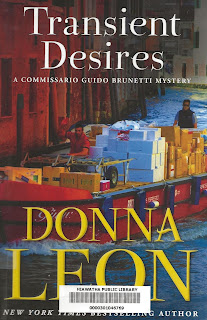
Review Dona Leon's TRANSIENT DESIRES


Leon, Donna. Transient Desires

I have read a number of Donna Leon’s thirty books that feature the quiet and cerebral presence of her detective Commissario Brunetti, his colleagues, and his family. By the time you are finished with any one of them, you feel as though you have had a grand tour of every nook, cranny, canal, and bridge in Venice. You will also have eaten your way through many cups of coffee, morning snacks, and various gourmet offerings of pastas, meats, and fishes.      

Would I be remiss if I now say that there was an engaging mystery here as well. Two young men pull up at the boat dock of a local hospital and abandon two injured women to start Brunetti on the case. It does not take long, however, to get a glimmer of even more serious ventures happening far out at sea. It takes some intricate maneuvering, a cooperation from other agencies, and some very modern surveillance devices to find and nail the real culprits.

Things develop a bit slowly at first, but as the pieces come together there is a fine development of suspense. If you like intricate local color, a philosophical detective, and subject matter that thrusts you into criminal activity and emotional entanglements that are as up to date as today’s newspaper, you will find Ms. Leon’s book a fine read.    


Thursday, February 03, 2022

The Witch's Child by Susan Van Kirk


The Witch’s Child a review by Jim De Young

Susan Van Kirk has recently added another volume to her “Endurance” mystery series and before I get started, let me add a disclaimer. The author is a good friend, former neighbor, taught our children in school, and has let my wife be one of her pre-publication readers. i.e. I have some bias. In addition I will admit to preferring my murder mysteries set in more exotic locales and with a bit more grit.

No matter. I believe you will enjoy The Witch’s Child as long as you do not think you are getting Stieg Larsson and the dragon tattoo lady. The book falls neatly into what is called the “Cozy Mystery” genre.  If you are not initiated into its form an internet search can bring you quickly up to speed.  Cozy mysteries take place in small, picturesque towns or villages, with characters who you could envision having as neighbors or friends. (Of course, once you find out who the killer is, you probably wouldn’t want that person living next to you.)  Cozies generally don’t include a lot of gory details, violence, rude language, or explicit adult situations. They are marketed strongly, but certainly not exclusively, to female readers.   

The Witch’s Child fits this genre to a tee. The heroine, Grace Kimball, is a retired small town English teacher whose loving husband has passed away. She lives in a not accidentally named small town called Endurance. In more-hard boiled mysteries the sleuth (whether amateur or professional) is almost always a city dweller, often a loner, divorced, has a hard time with authority, or is fighting a multitude of other demons. Grace Kimball is a likable person. She is a well-mannered, well- respected, and basically well-adjusted woman. If she has a problem, other than whether her latest squeeze will propose or not, it is that she spends too much time in coffee shops.

In this offering she finds herself emmeshed in the life of a former student named Fiona Mackensie. Fiona claims to be a Wiccan and has just returned to town to bury her mother, who has died in prison—sentenced there because of the unlicensed practice of midwifery. Her mother’s first name was Sybil and forgive the literary guy for noting that the name has been long associated with second sight, fortune telling, herbal remedies, witchery, and other nasty black arts. Small towns have long memories for this kind of thing and the return of Fiona ignites many of them.

The blaze gets deadly when Graces’s friend, a local retired judge, is murdered by a plant based poison. (Kudos inserted here because, like Agatha Christie, Van Kirk has done her poison and dark arts background research carefully and convincingly.) Grace wants to help her former student (Fiona), as well as solve the murder.  This is mostly done interspersed with trips to the local coffee shop and meetings over fine home baked delicacies. She is helped in her endeavors by her town detective friend T J Sweeney, and her newspaper editor boy-friend. Adding to the fires of conflict is a local college professor, who has marshalled the forces of the outside media in order to increase the sales of her biography of Fiona’s mother.    

I do think the ending calls for some stretching of coincidences, but the overall result nicely captures the follies, foibles and fears of its small town setting.  Give it a read!

Monday, January 31, 2022

Martha Grimes DUST review


Grimes, Martha.  Dust  2007

Dust is a nice throwaway mystery with Richard Jury doing most of the detecting on a murder in a hotel room. His Long Piddleton friend Melrose Plant contributes nicely without the long involvement of some of the other habitues of the town pub. There are red herrings galore and you may miss some of the allusions if (like me) you are not well enough acquainted with the works of Henry James. The hot affair between Jury and a sex obsessed fellow detective gets some period chapters and looks more like a set up for future books than something necessary to this one. 


Wednesday, January 19, 2022

Book Review The Lamorna Wink


The Lamorna Wink by Martha Grimes

I started my love affair with Martha Grimes when I ran across her early work titled The Dirty Duck. Any theatre nut will immediately recognize that this is one of the names of a pub in Stratford Upon Avon that sits close by the Shakespeare Memorial Theatre.  That book puts her major detective, Richard Jury,  in the city and is full of theatrical lore.  From then on, my experience with Grimes has been up and down.

The Lamorna Wink, unfortunately, is one of the downs. Although advertised as a Richard Jury Mystery, this offering leaves Jury out of the picture entirely until the final chapters. Instead, we get the stuffy lump, Melrose Plant, trying his hand at detection.  Plant falls in love with an old mansion in Cornwall and since he has endless money just decides to rent it for a while. The rental includes inheriting the unsolved tragic death of two youngsters in the sea at the bottom of the cliff upon which the house sits. All of Grimes’ skill in description goes for naught as Plant and a few of his Long Piddleton cronies drink their way through the mystery.  Plant and his friends provide humorous counterpoint in the more normal Jury mysteries, but they simply cannot carry a book by themselves—even if it delves into the world of child porn and snuff films.  Don’t bother!

On the other hand this might be the time to urge the theatre folks who might read this to take a look at  Grimes'  The Dirty Duck.

Here is a bit of what I wrote several years ago. 

 What theatre lover doesn’t feel a rise in heartbeat at the mention of the Royal Shakespeare Theatre in Stratford Upon Avon or the walk along the Avon out to the Holy Trinity Church?   Wouldn’t there be an additional adrenalin rush if there was a nasty Jack the Ripper style killer knocking off American tourists left and right?  Martha Grimes has now written some twenty Richard Jury mysteries.  The Dirty Duck, written in 1984, was the fourth in the series.  Her work, at least in this early effort, lacks the depth of texture found in P.D. James or Elizabeth George, but it does have a headier sense of irony and humor. The characters tend to live in within the more exaggerated stereotypes of Britons and Americans. Names tend to be on the jokey side as in Melrose Plant, or Honey Belle for a woman from the American south. The book takes you to every Shakespeare haunt in Stratford and then adjourns to London for action in the West End, Southwark, and Deptford.  Anyone who has followed a couple of my London Theatre Walks will find themselves in familiar territory.  

Featured Posts

WHISTLER by Ann Patchett

  I have never read a book by Ms. Patchett. I may read another after reading this one. I...