Sunday, January 23, 2011

Leona Vicario--A Town to Remember


Leona Vicario, Mexico is a small town of around 10,000. That makes it just about the size of  my home town.  According to our trusty guide Rob,  the Mayans have started moving to more modern small towns so that their children can go to government schools and learn Spanish.  The native Mayan language is totally unrelated to Spanish and knowing only it means linguistic isolation from the rest of Mexico as well as the world at large. Leona Vicario has also just begun to look for tourist income and the residents are building a new palapa in the town center to serve as a visitor and craft center. 


We stopped first at a small market area where we saw a small tortilla factory (the sign out front called it a tortileria).  After we had a sample of their freshly produced wares we walked over to get some fresh squeezed orange juice from another vendor.


We then were bundled into a bunch of three wheeled pedicabs that Rob called “triciyclettes” for a rolling tour of the town.

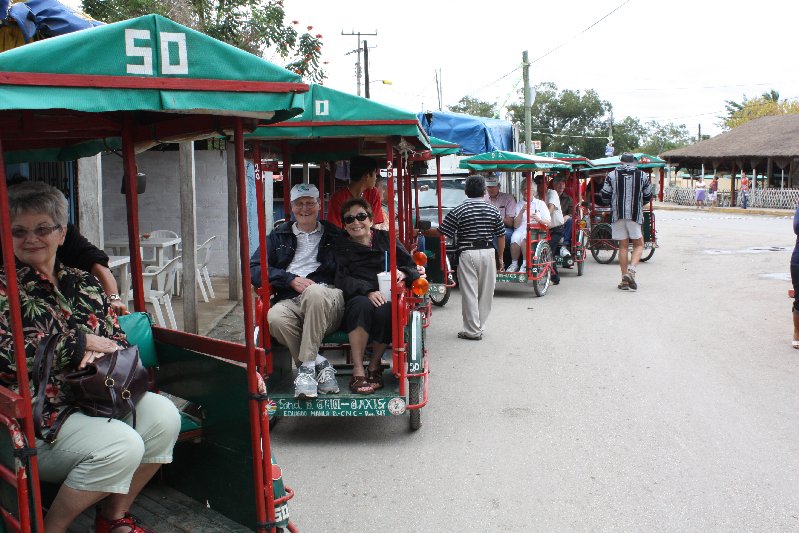


A Swiss expatriot named Christian was one of the pedicab operators and a friend of our guide. He also came, stayed, and married a Mexican woman.  He is currently the only foreigner living in Leona Vicario.  

Native Mayans are fairly short and Christian (in red hat) is a good head taller.

Our route through the town took us down typical streets where people were going about their normal routines of hanging out laundry, shopping in the market, or escorting children home from school.


One of our stops was at the home of a young woodworker and his family. He constructed his two lathes out of spare parts and now turns out mortars and pestles, bowls, pots, and vases. His sons have started to help at an early age.  We admired the work ethic, but with no child labor laws or OSHA regulation here, the homemade machinery has no protective coverings and noone wears eye goggles.


Here are some of their finished products.


 There were lots of kids everywhere we went and as usual they were curious, coy, and always cute.  


With our town tour complete we piled back into our van and headed for a home-cooked Mayan  meal at the Cenote Las Majarras.  You don't know what a Cenote is?  Well we'll tell you and show you in the next entry.


Saturday, January 22, 2011

Into the Jungle for a Visit to a Chicleros Camp

On our second  trip out of the "Cancun Cocoon" we returned to the Yucatan jungle. We were a group of ten people in a van with a guide and driver. The guide was an expat German named Rob who arrived on holiday some fifteen years ago with his fiance, got married, and stayed.  He now sells real estate and guides tours for a living.  You couldn't ask for a more lively and knowledgeable fellow.


Our first stop was at what Rob called a Chicleros camp. Workers stay here during the week and go home to their wives and families on the weekends. Each day they go two to four kilometers into the jungle to tend and harvest the gum from the manilkara tree. The end product is chicle-- the rubbery substance that ancient Mayas used to use to clean their teeth--and originally the main ingredient in chewing gum. Synthetic materials are now used for most chewing gum, but the name still remains if you buy "Chiclets." The harvesting is similar to the sugar maple or the rubber tree. Below are a couple of shots of a tree and its chicle trickle. 
A slash or slit is made in the tree and the sap runs slowly out.  This can only be done every three years on a tree.
 
The gum is collected in canvas bags that are hung on the trees.

Everyone was off to work when we visited so we had to make do with the resident cat named "Puma."  Had he not been so skittish we could have said that we petted a puma while in the jungle. 


The resident milk producer was also around, but she was busy too.


While in the camp the men live off the land and their animals.  Our guide said there were usually some chickens around but there had been bad hunting last week and the chickens had disappeared.  All the workers, he said,  carry guns to pick off game they may encounter  as well as any unwelcome strangers who might happen into their territory.  Hopefully that was a joke, but he wasn't laughing when he said it.

The general living conditions are pretty rudimentary.  

Eggs decorate the roof of the sleeping area--to promote fertility according to our guide.

Here is the living room. Didn't see a TV anywhere.


Here is the shower. Note ladder on left that you climb in order to pour water on the showeree.

The kitchen is fully equipped.


After work recreation appeared to be liquid in nature.  Note pile of crushed beer cans around tree.
Rob also gave us a short lesson in jungle remedies and dangers.  He showed us some termite poop that grew inside hollows in trees that could be used to treat sores and cuts.


 He pointed out some leaves that if crushed and eaten would mediate diabetes and then said that drug companies were not interested in these kinds of natural remedies because they could not be patented.  "The drug companies are not interested in your health" said Rob, "only your money."   He also pointed out a tree that if you came into contact with it would cause you to burn fiercely and also a tree not twenty-five yards away that he said would relieve the pain. Noone in our party volunteered to try it out.  Nor did he.

On the way back to the van we stopped to inspect a wild cotton bush that was all ready to harvest.


Then it was on to Leona Vicario, a small Mayan town which you will tour with us in the next chapter of  Stirring the Pudding.

Wednesday, January 19, 2011

CHECK MARK CHICHEN ITZA!

It began with a boy reading and loving Richard Halliburton’s Book of Marvels when he was around eight years old. The boy dreamed with all his might of seeing some of those fifty-five wonders of the world for himself someday. Sixty five years later there are twenty-five little checkmarks in the Table of Contents of my copy of that book.  That means that I've only reached about half of the places that Halliburton visited and wrote about in the 1930’s, but I am beginning to make a dent in the planet’s magnificent natural and man-made wonders. Specific dreams already fulfilled (all of which Halliburton covered) range from the Pyramids to the Parthenon and Mount Fuji to the Matterhorn.  In the past few years three more checkmarks have appeared.

My wife and I traversed the Panama Canal (though we did not swim it as Halliburton did); we have visited Niagara Falls (only fifty-one years after we were married); and this past week we experienced the thrill of walking on the sacred ground of the Maya at Chichen Itza in Mexico’s Yucatan peninsula.


There are four major structures to be seen at Chichen Itza. The signature temple called “El Castillo” (pictured above) is over 200 feet high. The ancient ball court is the largest ever found and the astronomical observatory was the central location for the Mayan priest’s study of the skies and the development of their astonishing  calendar.


But my interest always centered on Halliburton’s description of the sacred well where (according to his somewhat hyper-ventilated narrative) gold bedecked Mayan maidens and armored Mayan warriors were sacrificed to Yum Chac the God of Rain by propelling them off a ledge and down some eighty feet to their watery deaths.  


Although Halliburton's prose is a bit too breathless for today's media generation,  to a kid in Milwaukee in the late 1940’s it sounded like heavenly music. To top off his visit Halliburton wanted to experience what it might have been like to be thrown into the well so he jumped in himself.  A grainy picture of his leap appeared in the book and that photo entranced me then and fired my drive now to see that place.

 Here he is dropping like a stone to the green algae covered surface of the water. He said he got quite a headache from hitting the water. Luckily they don’t allow jumpers anymore, so I was spared from trying to completely emulate my hero.  And besides it was already raining so Yum Chac didn't need my contribution.


Look for more in the next week as I put up some additional material on our trip.

Sunday, January 02, 2011

What a Wonderful Christmas This Year!

 
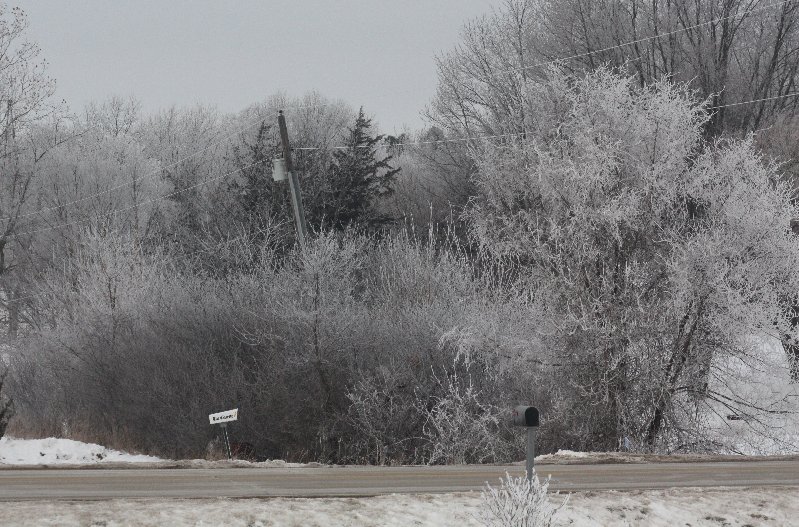
Our Christmas season worked beautifully as we managed to hit all the marks inbetween snow storms.  We drove to Cedar Rapids in nice weather and saw the snow come down while we were there.  A beautiful scene from the patio captured the calm essence of a snow frost morning.   


We celebrated our grandson's birthday--not quite but almost a Christmas baby.


Then it was on to Christmas itself. 

Grandson two was really excited about the guitar that his uncle David brought him.   And grandpa loved his Chia Obama


Back home in nice weather and then the snow came down once more. 


But were snug inside and had a lovely Christmas day.  We opened more presents, got to know David's friend Lotta who traveled all the way from Finland over the holidays, and settled down to a great dinner.


 Our Minnesota guests headed back north on Sunday and made it back without problems.  Although there was more cold and blowing snow west and north of us we got  a warm spell midweek and rain that melted every last bit of the snow.  We are now looking at bare ground once more. 

New Year's day was quiet and subdued.  The last of the lights were taken down and the tree, which was one of our nicest in several years, is now sitting a bit forlornly on the curb waiting for the trash pickup next week.  We shall choose to remember it as it was.   


And Happy New Year from the guy behind the camera.  

Featured Posts

God’s County by William Kent Kreuger

    My quick first thought about this book was that Kent Krueger now shares a useful symbol with Louise Penny. Both writers have promine...