Wednesday, November 20, 2019

Chapter II: Nez Perce Program and Jet Boat Ride into Hells Canyon


                                   Chapter II: Nez Perce Program and Jet Boat Ride into Hells Canyon

Our ship docked in Clarkston/Lewiston late in the evening of October 6th. Right after breakfast the following morning we had a program by a Nez Perce Indian named  J.R. Spencer. He was in full costume and carried a drum and native flute, which he played to accompany his recounting of some of his ancestor's ancient myths. 


 His talk also was sprinkled with humorous references to the modern day and his life both on and off the reservation. This kept his presentation upbeat and refreshing in spite of clear references to the long history of mistreatment of native peoples.


Shortly after his talk we trouped outside to the dock where two jet boats were moored to take us up the Snake River and into Hells Canyon.


These boats are propelled by sucking in water at the front and then pumping it out the rear at high speed. At full throttle they can reach 30 miles an hour--though they are definitely noisy. They have an  advantage over a traditional speed boat as without a drive shaft and propeller below the bottom of the boat they can operate in shallower water  and rocky rapids.

So we settle into our seats.


Our driver and guide is in place


and away we go.


Unfortunately this little movie segment does not appear to work. Not sure at moment why not.


A coastal road shadows the  Snake river for the first miles out of Clarkston\Lewiston,


When the road ends the dwellings rapidly get fewer and further between.  Some are minimal camping shelters.


Others have clearly been constructed by members of the monied class.  They could afford to bring in builders and construction supplies by boat, raft, or even helicopter. These places usually have , picture windows, solar panels, satellite dishes, and well manicured shorelines. Our guide even mentioned one well heeled resident who carved himself out an airstrip,


Around noon we stopped for lunch at a parcel of land owned and operated by the national environmental organization Nature Conservancy.  It is appropriately named Garden Creek.


A caretaker family lives there year round. Some supplies come in by boat but they do exist largely on organic gardening. They tap a mountain stream for irrigation and grow delicious apples and pears in their orchard.


We had a delicious pulled pork and baked beans lunch on a riverside patio


 and feasted on a dessert of organic apples and pears pulled directly off the trees.


 We also shared the grounds with some four footed visitors.


We re-boarded the jet boats after lunch and headed upriver a bit further into the canyon.


As we continued to motor smoothly up through quiet fishing spots and white water rapids,


we could easily imagine how different it would have been for the Lewis and Clark party as they attempted to paddle and control their hand built dugout canoes on this river.  According to the journals the natives were unimpressed with the white men's construction skills. The further up the river we went the more isolated it became.  We were, however, reminded at one point that this river was a highway long before the Corps of Discovery set their canoes on it. The "ancient ones" had been there long before.


The canyon is home to other denizens as well.  Thanks to our tour photographer, who had a great long lens, we received some nice pictures of  Bighorn Sheep that were grazing on the mountain sides or getting a cool drink from the river.


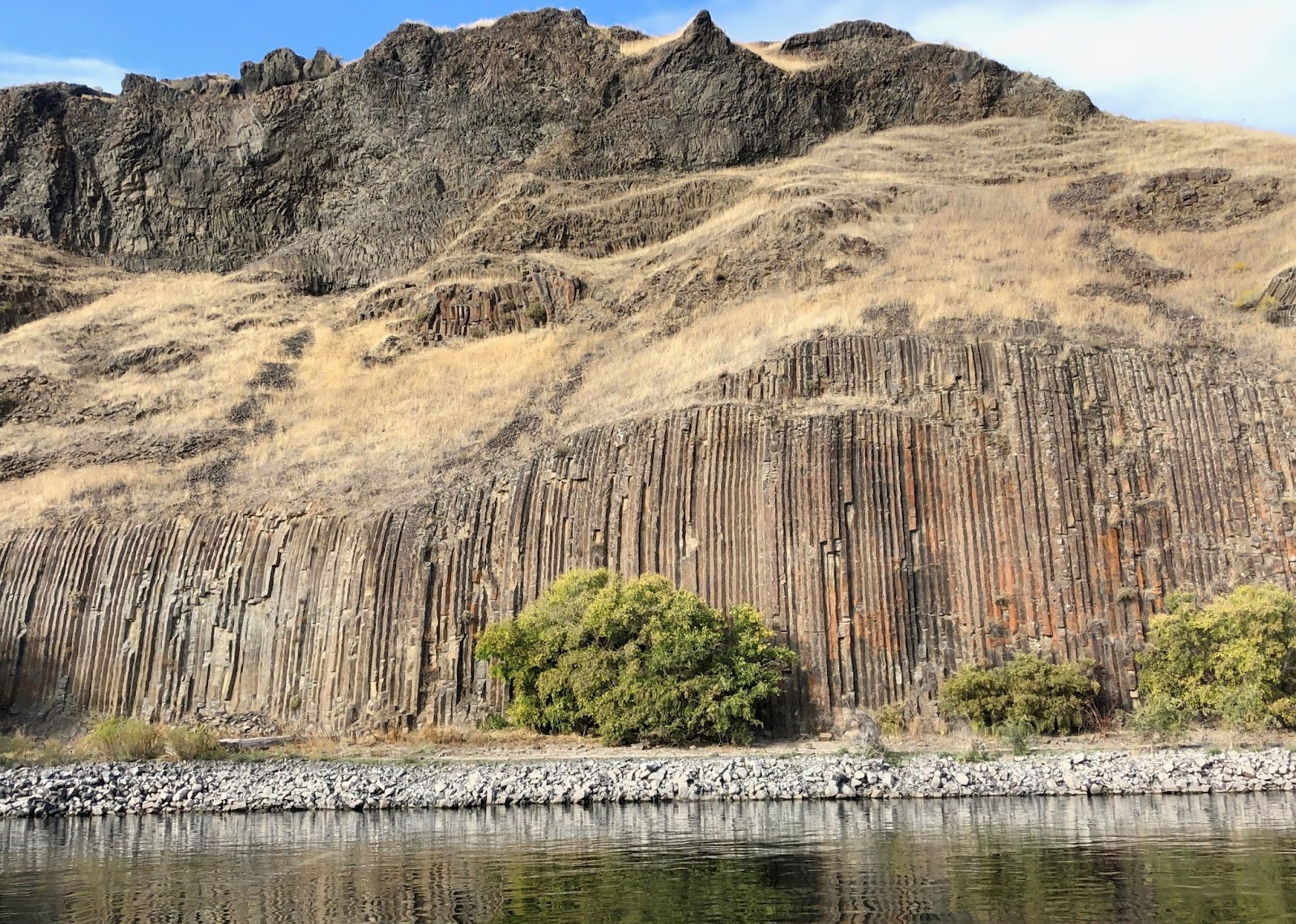
And always the scenery and the geology kept us enchanted.


Our guide noted that this area was home to both gigantic volcanic eruptions as well as inundation by vast seas.  Thus you can see the evidence of major sedimentary deposits as well as volcanic extrusions of basalt in what is now exposed in vertical pipes.


Often the views are pretty placid.


but this shot lets you know that the river does fluctuate--especially during the spring.

It's time to head back downriver now our dock in Clarkston/Lewiston.


Monday, November 18, 2019

Chap I: Introduction, Lewis and Clark and a small ship cruise on the Columbia and Snake Rivers

Chap I: Introduction, Lewis and Clark and a small ship cruise on the Columbia and Snake Rivers


Meriwether Lewis and William Clark didn't think they would be gone for 2 1/2 years when they started their journey up the Missouri River in May, 1804.  President Thomas Jefferson was hoping to discover a water route to the Pacific, but he was to be disappointed in that hope when Lewis and Clark found themselves on the craggy slopes of the Bitterroot mountains and the freezing cold of the Lolo Pass.  Luckily the "Corps of Discovery", which was the official name of the Lewis and Clark expedition,  pressed on over the Continental Divide, and found the Clearwater River which flowed into the Snake River which flowed into the Columbia River and from there to the Pacific.  They had established the  connection to the West and ultimately provided maps, information about the plant and animal life, and descriptions of the native inhabitants--albeit without delivering to  Jefferson that hoped for all-water route to the great western ocean.   

Our week long cruise on the Columbia and Snake Rivers followed  the last section of the Lewis and Clark route.  It started with a drive to Chicago where we parked our car, and then flew to Portland, Oregon to board our ship the Wilderness Discoverer.


For those unfamiliar with small ships let me give you a tour to differentiate them from the behemoth vessels that now tend to dominate the cruise market.  Our ship was compact and without the more elegant refinements found in larger and newer vessels.  It had the essentials without the pools, water slides, fancy auditoriums, private cabin patios, multiple dining rooms, and casinos.  We had spent time on a smaller ship on a previous Road Scholar trip through the Panama Canal and had no qualms about joining this one.  It was our 7th Road Scholar trip and older folks may recall that this organization started as Elderhostel  but was renamed a few years ago.  Their tours are generally marketed as more educationally oriented and  more all-inclusive than some.  In particular they include all  meals, tips and gratuities in their price.

Our tour group of about seventy people filled the ship and was served by another twenty or so young cabin attendants, servers, and deckhands. We made a small and companionable group.  Let me now give you a quick rundown of our on temporary water home before we actually get under way. 

Our cabin was compact with the bathroom combining both shower and stool. Luckily you don't spend a lot of time in your quarters. 


There was plenty of room outside for walking and exercise. You could do a mile around the main deck with around 24 loops. The stern even had two hot tubs and some exercise equipment.  The dining area was amidship on the main deck and was simple, clean and pleasantly  appointed without the ostentatious gaudiness so common to the larger ships.   


Meals, as on most cruises,  were excellent and somehow cooked up by our chef in a space that seemed about the size of our kitchen at home.


The crew kept everything spit spot and we caught them one evening polishing up the floor by skating on it with cloths on their shoes. 


The forward part of the main deck had a lounge area with chairs and small tables for general relaxation, conversation, or reading. There were TV screens in there that became available for visuals associated with our scheduled lectures.  No real TV though as we were off the grid for a lot of our journey.


The lounge area also included a fully equipped libation center staffed by a  lively bartender who made up a special drink each evening to start off the cocktail hour with a nice conversation starter.


Our sailing itinerary took us up the Columbia and Snake Rivers to Clarkston,WA/Lewiston, ID where we transferred to a so called jet boat for a speedy day trip further into Hell's Canyon on the Snake River. We returned to our dock to re-board our "small ship"  for a long cruise back  through Portland and all the way on to Astoria, OR where the Columbia empties into the Pacific Ocean.  On our final night we sailed back upriver to Portland where we disembarked and headed for the airport to fly back to Chicago and home.   

With this brief look at our ship, I will turn in the next entries to our stops and how they integrated with the travels of  Lewis and Clark and the men (and lone woman) who made up the "Corps of Discovery."  Look for it in another few days.


Saturday, November 09, 2019

Berlin in 1963--With the Wall just two years old

Thirty years ago today the West celebrated the tearing down of the Berlin Wall.  The pictures on TV concentrated on images of wild celebration.  But some of you might be wondering what it was like to live in East Germany during the years of the Wall. In the summer of 1963 my wife and I took a train through East Germany and into the encircled enclave of  the city of Berlin. On the way through the East the train was locked down and no photos were allowed. Our passports were checked by coldly suspicious soldiers carrying machine guns. It was just two years after the wall was erected.  My photos have dimmed a bit over time, but they are good enough to make the point about a world that was and a world that could easily return if our society continues to tolerate approval or studied nonchalance when faced with open evidence of the stifling of dissent, corruption, racism, or  constant vituperation and  falsehoods.

Would you like to live here?  This is my favorite photo of the Berlin Wall  because it speaks visualy to the real nature of totolitarianism.  You are looking at the front of the Brandenburg Gate which was just inside the Eastern Zone.  It is in plain view and only a matter of a few paces from the Wall  yet unobtainable behind the barrier and the barbed wire.


This photo shows the gate from the side with the wall and an admonitory sign.


Here you can see a West German Street that was literally truncated at the wall,  which runs almost invisibly in the background.


Officially, as citizens of one of the four-power ruling coalition that controlled the city of Berlin (USA, France, England, and Russia), we were allowed to enter the East Zone through the historic Checkpoint Charlie. Below are pictures of the vehicle entrance and the pedestrian entrance as it looked in 1963.


Once in the East you were struck by an obvious change in general environment.  Streets were broad but fairly empty of both vehicles and people. 


Newer post-war buildings were somber, utilitarian, and unadorned.


This building was nearer to the wall and the roof  edge, though hard to see from this old slide, was covered with barbed wire.


Below was an East German play area that ended at the wall just visible in the background.


At first East German buildings abutted closely to the wall, but soon more of these structures were razed in order to form a so called dead zone through which escapees would have to traverse or tunnel under before they could reach the West. 


Back in the West the contrast was even more apparent. The streets and buildings were more open. modern, and inviting.  WWII damage and rebuilding was clearly moving more rapidly.


And that is my tribute to the tearing down of that Wall.  

Monday, September 30, 2019

Bernhardt/Hamlet Struggles at the Goodman Theatre


I really wish I could be more positive about Theresa Rebeck’s  Bernhardt/Hamlet which is currently running at Chicago’s Goodman Theatre. I am a theatre historian and director by trade and anything about the nature of theatre and its practitioners is always an attraction for me.
Unfortunately Ms. Rebeck lost her way somewhere along the long gestation of this piece and has produced an occasionally amusing piece of backstage gossip that ends as a pastiche that might better be named Bernhardt/Rostand.
From a performance point of view Chicago’s own Larry Yando steals the acting honors while the rest of the cast including Terri McMahon as Bernhardt recedes into the bric-a-brac strewn all brown stage of Ms. Bernhardt’s theatre in Paris. It contains the detritus of all rehearsal spaces which here means racks of costumes, book shelves on wheels (Remember the recent Music Man), tables and chairs, walls hung with old props, etc. The scenic environment is dominated by two puzzling features I have yet to connect to the play. First there are two flying canted chandeliers that seem to have been pirated from the Phantom of the Opera. Why? Not sure--maybe the out of kilter world.  Also puzzling in the set are two stuffed deer heads that are given special spotlights so someone must want us to look at them. Again I am not sure what they are supposed to represent--perhaps they are two more of Sarah’s expired exotic pets.
Now on to the content. Act I gives us a strong and lusty actress who argues persuasively to several male friends, including her current lover Edmond Rostand, that she has every right to play Hamlet and not be kept to the lesser female roles in the play. We get this argumentative thrust along with snippets of rehearsal scenes for about fifty minutes before a rather quiet act ending. As the 2nd act opens Sarah’s affair with Edmond Rostand starts to take up more and more of the oxygen of the play. Rostand is trying to finish his Cyrano de Bergerac while trying to keep Madame Sarah from rewriting Hamlet into more understandable prose. Rostand’s long suffering wife, a strong Jennifer Latimore,  appears with the script of Cyrano in hand to plead that Sarah stop trying to usurp her husband’s time and let him finish his master work. This is followed by Larry Yando’s rather lengthy star turn in a scene from Cyrano itself. With three quarters of the 2nd act now devoted to juicy turns by actors other than the lead, we do need some more potent fireworks to return us to the central issue of gender switching. What we get is a smattering of sword play and finally Ms. Bernhard, rapier in hand, dancing upstage as the rear wall slides aside to reveal a strobe lit and smoke filled Valhalla. It is a clear intent to elevate Bernhardt to some kind of rock and roll stardom via a note that her Hamlet appearance was saved by a silent film clip, but I’m afraid it just came off as a bit hoky to me. The coronation just doesn’t seem earned by anything we have seen Sarah or Teri McMahon say or do in the play. Maybe if McMahon’s Sarah had more star oomph, it might have come together, but it didn’t and I left the theatre feeling as though an average dinner ended with a missing dessert.    


Featured Posts

Review of Marie Benedict's The Queens of Crime

  Benedict, Marie The Queens of Crime As a long-time lover of detective novels, I was intrigued by the central idea of Marie Benedict’s 20...